
For most solo founders, building a Lovable MVP costs $25 to $100 a month while you build, then about $25 a month to keep it online. That is a Pro plan at 100 to 400 credits, plus a domain for about $10 to $15 a year and payment fees once you charge. The plan price is predictable. The number of credits you burn is not: it depends on how big your first version is and how you prompt.
This guide walks through Lovable's pricing page plan by plan, explains exactly what a credit buys, shows how many credits real MVPs have used, and turns that into budgets. It also covers the costs that are easy to miss: the backend, AI features inside your app, and what happens to a live app when credits run out.
How we checked: plan prices, credit rules and hosting terms come from Lovable's pricing page and documentation, read on 1 October 2026. The screenshots below were taken from the US version of the pricing page the same day. Lovable changes its pricing often; its changelog records billing changes in almost every quarter of 2025 and 2026, so check the live page before committing to an annual plan. This guide has no sponsor.
Lovable's plans at a glance
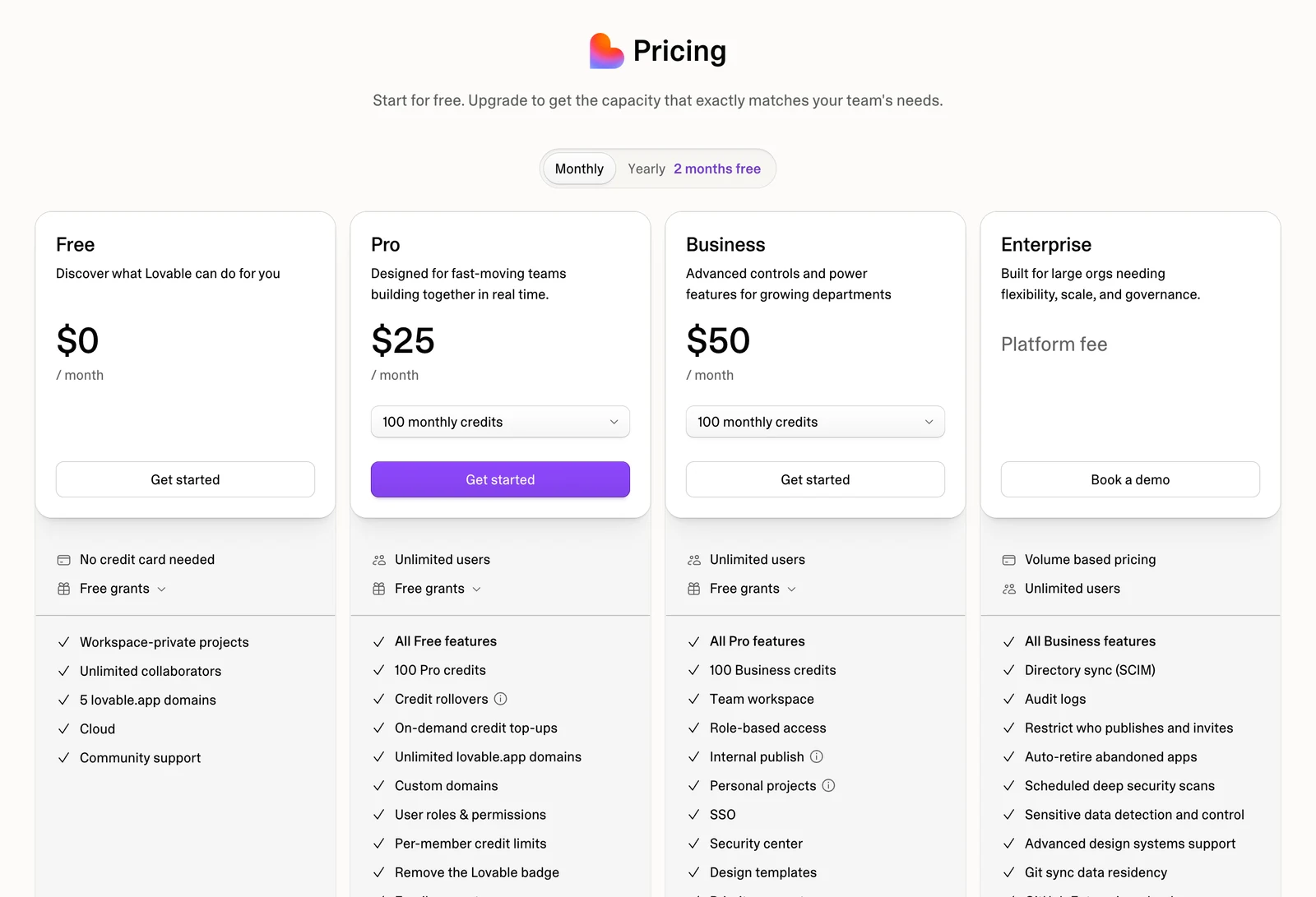
| Plan | Price | Credits | What it unlocks |
|---|---|---|---|
| Free | $0 | 5 build credits a day, capped at 30 a month | Private projects, unlimited collaborators, Git sync, 5 lovable.app addresses |
| Pro | $25/month or $250/year | 100 a month, plus 5 daily build credits | Custom domains, badge removal, code editing and download, credit rollover, top-ups, per-member credit limits |
| Business | $50/month or $500/year | 100 a month, plus 5 daily build credits | Everything in Pro, plus SSO, team workspace, role-based access, internal publishing, security center, data excluded from AI training by default |
| Enterprise | Platform fee, volume based | Custom | SCIM directory sync, audit logs, publishing controls, scheduled deep security scans |
Three details on this page change the maths more than the headline prices:
- No per-seat pricing. Every plan says "Unlimited users". A co-founder or freelancer can join your workspace without raising the bill; they spend from the same credit balance. Pro lets you set per-member credit limits so one person cannot drain it.
- Annual billing is "2 months free". Pro-100 costs $250 a year instead of $300, which lowers the effective credit price from $0.25 to about $0.21. Only commit annually once you know you will keep building for a year.
- Students get up to 50% off Pro, per the subscription plans documentation, on monthly billing for up to 12 months.
Choosing a Pro credit tier
The Pro price is set by the dropdown under the plan name. Opening it shows the full ladder of monthly credit tiers:
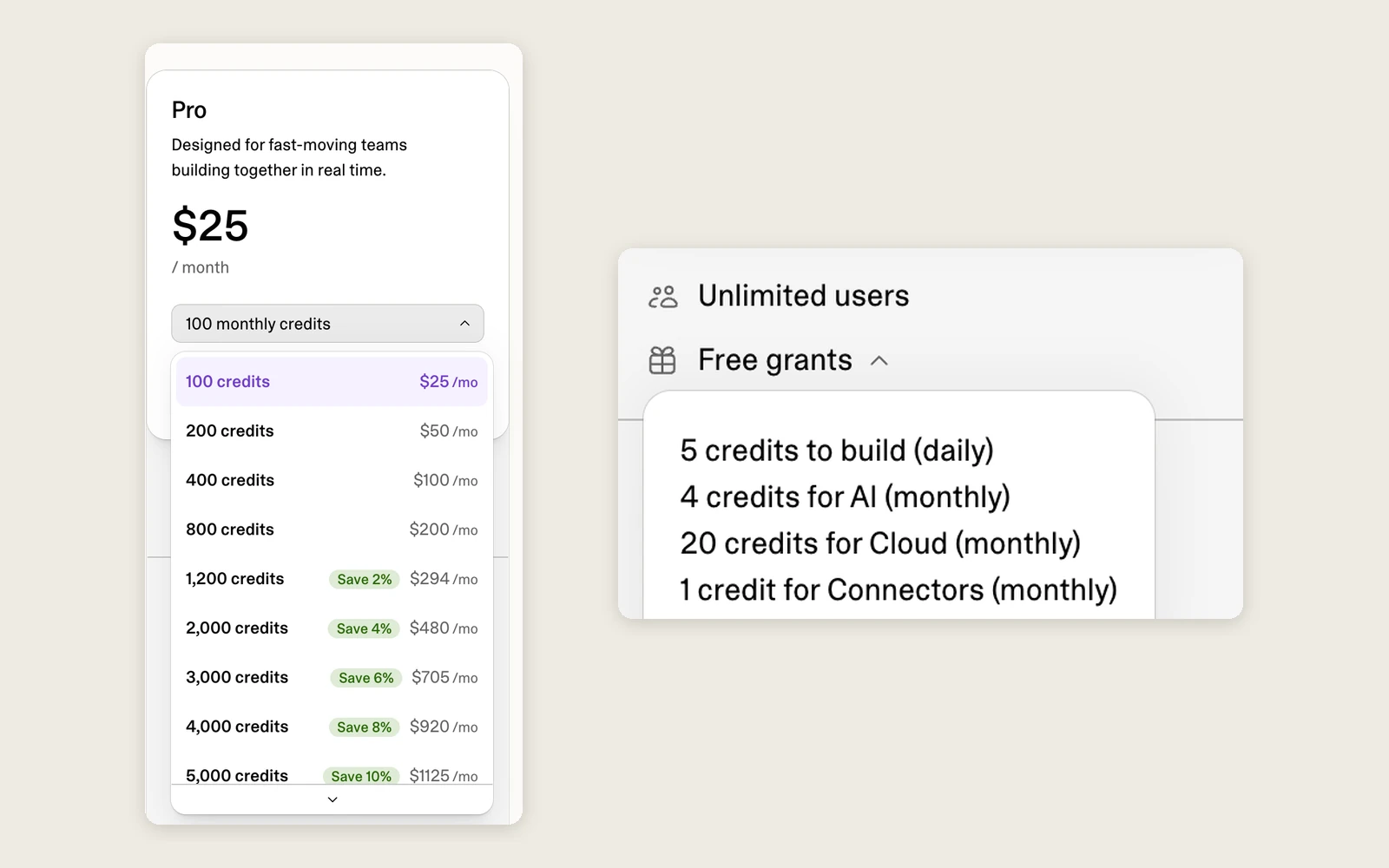
| Tier | Monthly price | Cost per credit | Notes |
|---|---|---|---|
| 100 to 800 credits | $25 to $200 | $0.25 | No volume discount at these tiers |
| 1,200 credits | $294 | $0.245 | First discounted tier (2%) |
| 5,000 credits | $1,125 | $0.225 | 10% discount |
| 10,000 credits | $2,250 | $0.225 | Highest published tier |
| Pro-100, billed annually | $250 a year | About $0.21 | Two months free |
| Top-up | $15 per 50 credits | $0.30 | Valid for 12 months |
For a solo founder, the practical takeaway is simple: every tier up to 800 credits costs the same per credit, so pick the tier that matches your real monthly use and change it as your pace changes. Lovable supports self-serve upgrades and downgrades.
Top up or upgrade?
Top-ups cost 20% more per credit than plan credits, but they last 12 months while plan credits expire after two. That makes the choice a matter of whether your extra need is a one-off spike or a steady pace:
| You need each month | Pro-100 plus top-ups | Next tier up | Cheaper option |
|---|---|---|---|
| 150 credits | $25 + $15 = $40 | Pro-200: $50 | Top up |
| 200 credits | $25 + $30 = $55 | Pro-200: $50 | Upgrade |
| 300 credits | $50 (Pro-200) + $30 = $80 | Pro-400: $100 | Top up, unless you use the full 400 |
Lovable's own guidance is the same: if you consistently run out before renewal, upgrading is usually more cost-effective than repeated top-ups.
The free grants that come with every plan
Beside the monthly credits, each plan includes smaller grants for specific kinds of usage, shown on the right of the screenshot above. On Pro they are:
- 5 build credits a day. These are spent before your monthly credits and expire at midnight. On US Pro plans they are not capped at 30 a month, although Lovable notes that some regional plans cap them. Someone who builds every day can use roughly 150 of them in a month, which more than doubles Pro-100's effective allowance.
- 20 Cloud credits a month for hosting your app's backend: database, authentication, storage and server functions.
- 4 AI credits a month for AI features inside your app, which Lovable labels a temporary offering.
- 1 Connectors credit a month for connected third-party services.
Lovable spends these usage-specific grants first, then your general credits, starting with whichever credits expire soonest.
Is Lovable free?
You can build on Lovable for free, but you cannot run a business on the Free plan. Free gives you 5 build credits a day for the first six days of each month, 30 in total, according to Lovable. That is enough to test the product and build a small prototype, publish it to a lovable.app address and sync the code to GitHub.
The limits appear when you want customers. Free does not include a custom domain, removing the "Edit with Lovable" badge, editing or downloading code inside Lovable, top-ups or credit rollover. Apps created on Free since 13 May 2026 also have a traffic limit of 1,000 server requests per project per 10 seconds. Treat Free as a trial, and budget for Pro from the week you plan to charge.
How Lovable credits are spent
One credit balance pays for everything: building, chatting, running the backend, AI features in your app and connectors. The mode you work in decides the price of a message. Lovable's pricing page explains it in its credits FAQ:

- Build mode (the default) charges for the work completed. A small change can cost less than one credit; a large feature costs several. Adding authentication at 1.20 credits is roughly 30 cents on Pro-100.
- Plan mode costs 1 credit per message, plus any research Lovable runs while planning. Carrying out the approved plan is then billed as Build.
- Chat mode costs "typically a fraction of a credit" and first uses a free daily chat allowance. Lovable guarantees current chat pricing through 31 October 2026; after that it may change.
- Goal runs, where Lovable works through a longer objective on its own, cost noticeably more than single messages.
The documentation's version of this table lists the landing-page example at 2.00 credits rather than 1.70, a reminder that these are illustrations, not a price list. Two further rules matter for budgeting. If you stop a request part-way, you pay for the work already done; a request stopped before any change is free. And long requests pause at a check-in, 20 credits by default, so one runaway request cannot empty your balance without asking.
Some work costs nothing: security scans, publishing from the Publish dialog (asking the chat to publish costs credits), up to 10 free "Try to fix" attempts and 100 free inline text edits every 24 hours.
Measure your own burn rate in week one
Every message in Lovable's history shows what it cost; hover over its three dots. Rather than guessing, use your first week to measure:
- Note your credit balance at the start of each building session.
- After a week, divide the credits used by the number of features you finished, not the number of messages.
- Multiply by the features left on your list, and add about 30% for fixes and rework.
- Pick the Pro tier closest to that monthly figure, counting the daily credits you will realistically use.
How many credits an MVP takes
Lovable does not publish a typical figure per MVP. The most detailed public account we found comes from a development agency, Tessellate Labs, which tracked credits across ten MVPs it built in 2026. Treat it as one team's experience, not a benchmark: the agency sells development services, and experienced builders use fewer credits than first-timers.
| Project | Credits | Cost on Pro at $0.25 a credit |
|---|---|---|
| Lead-capture site | 38 | About $10 |
| Portfolio with a CMS | 64 | About $16 |
| Waitlist | 91 | About $23 |
| Booking calendar | 142 | About $36 |
| AI writing tool | 168 | About $42 |
| Marketplace | 201 | About $50 |
| Operations dashboard | 227 | About $57 |
| Habit-tracker app | 256 | About $64 |
| Subscription content site | 318 | About $80 |
| Multi-tenant invoicing SaaS | 812 | About $203 |
The median is about 180 credits, or roughly $45 of Pro credits. The spread matters more than the median: a landing page used 38, while a multi-tenant SaaS with teams and invoicing used 812. Scope, not the tool, sets the bill. Our guide to building an MVP you can charge for argues for the smaller version on business grounds; Lovable's pricing adds a cost reason.
Remember that daily build credits and rollover stretch the monthly figure. Monthly credits expire two months after they are issued, so a Pro-100 subscriber who builds lightly in month one can spend 200 credits in month two, plus whatever daily credits they use.
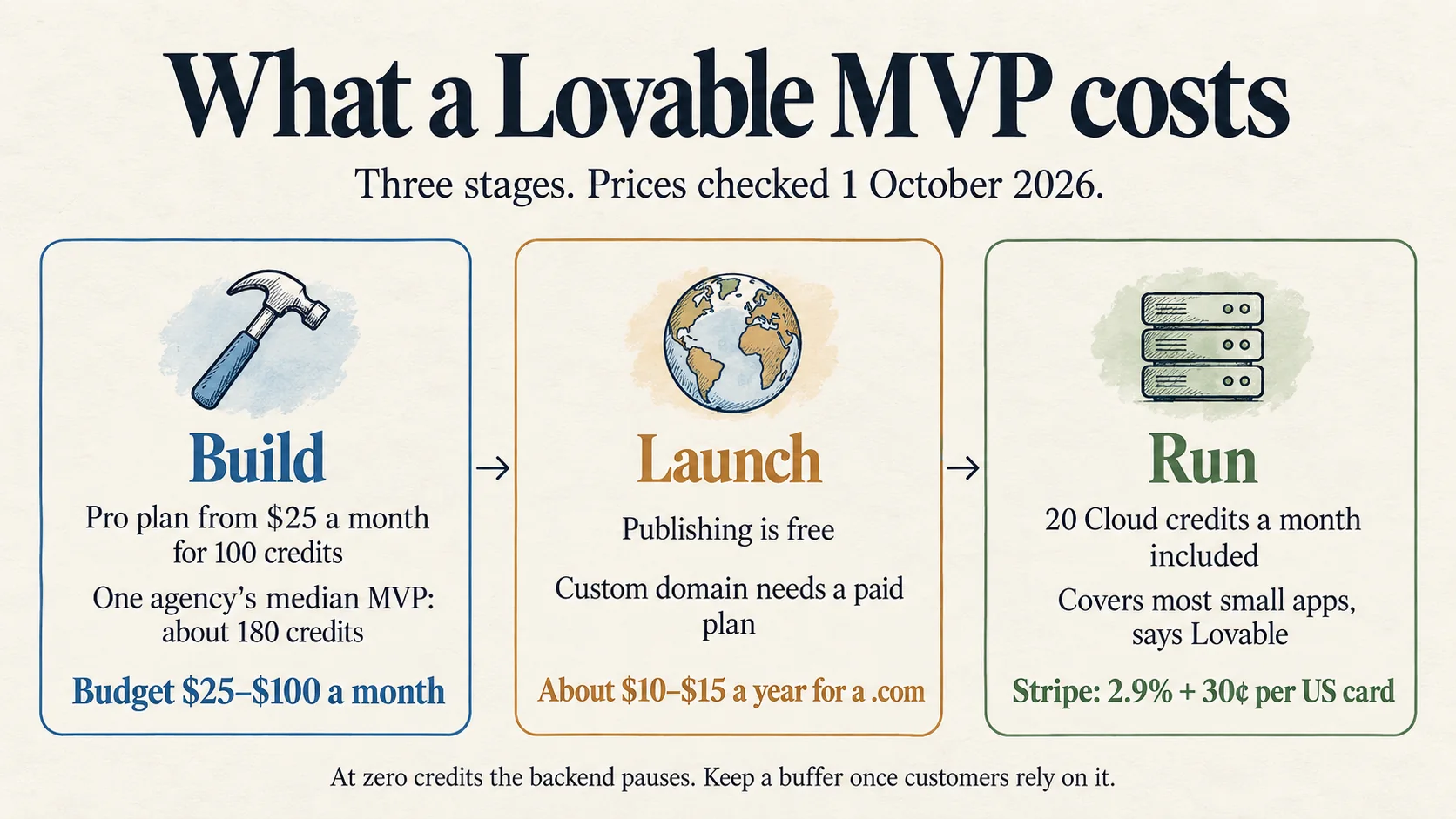
| What you build | Credits (reported range) | Likely plan | Build cost |
|---|---|---|---|
| Landing page and waitlist | 40 to 90 | Pro-100 for one month, or Free if you can wait | $0 to $25 |
| Simple SaaS: auth, database, one core workflow, payments | 150 to 320 | Pro-100 for one to two months, using daily credits and rollover | $25 to $50 |
| Larger app: teams, roles, billing, several workflows | About 800 | Pro-400 for two months, or Pro-800 for one | About $200 |
These assume careful prompting. Rebuilding the same feature three times, or asking for a complete app in one prompt and then fixing it, is how budgets double. Our guide on how long a solo founder should spend on an MVP makes the case for shipping the thin version first, which also keeps the credit bill down.
What it costs to keep the app running
Lovable Cloud is the built-in backend: database, authentication, file storage, server functions and realtime, based on Supabase's open-source stack. It is switched on by default and bills from the same credit balance, based on database size and uptime, storage, network and compute. You choose a database size from Tiny to X-Large; Free projects are fixed at Tiny, and storage starts at 8 GB and can only be increased.
For a small app, the 20-credit monthly Cloud grant is meant to cover it. Lovable says hosting for "smaller or new apps" is "fully covered by the included grant". Beyond that, Lovable does not publish per-unit Cloud rates; you see an estimated cost in credits inside the app. Check that estimate in your project's usage settings after launch rather than assuming.
| Item | What is included | Beyond the allowance |
|---|---|---|
| Publishing and traffic | Free on all plans; no visitor or bandwidth cap on paid plans | Not applicable |
| Backend (Lovable Cloud) | 20 credits a month | Billed in credits by database size, storage and usage |
| AI features in your app | 4 credits a month (temporary) | Billed in credits by model and tokens |
| Transactional email | 50,000 a month on paid plans | 4 credits per 1,000 emails |
| Custom domain | Connect one on any paid plan | Domains bought through Lovable are billed separately |
The risk to plan for: running out of credits
Lovable's documentation is clear about what happens when a workspace reaches zero credits. Building stops, AI features in your deployed app stop working, and the backend pauses shortly after. Your data is kept but cannot be accessed or exported until the backend runs again. The published front end stays online, so customers see an app that loads but cannot log in or save anything.
Cloud projects are also paused after a period of inactivity, which Lovable does not specify, and visits to the app do not wake them; you have to. Once you have paying customers, protect the app:
- Keep a buffer of at least a month's Cloud and AI usage in your balance.
- Turn on auto top-up with a monthly cap. The default adds 100 credits when the balance falls below 25.
- Set per-member credit limits so building experiments cannot drain the credits your live app needs.
- Check the usage page weekly until you know your app's normal monthly cost.
Lovable Cloud or your own Supabase
You can connect your own Supabase project instead, on any plan. It is billed separately by Supabase, and there is no automatic migration between the two in either direction, so decide early.
| Lovable Cloud | Your own Supabase | |
|---|---|---|
| Setup | On by default, nothing to configure | Create a Supabase project and connect it |
| Cost at MVP scale | Usually inside the 20-credit monthly grant | Free plan: 500 MB database, 50,000 monthly active users; Pro from $25 a month |
| If Lovable credits hit zero | Backend pauses | Database keeps running |
| Inactivity | Pauses after an unspecified idle period | Free projects pause after a week of inactivity; Pro does not |
| Leaving Lovable later | Manual export; files, server functions and secrets not included | Already yours |
Our view: Lovable Cloud is the right choice for validating an idea quickly. If you already have paying customers or expect to move the code off Lovable within a year, your own Supabase Pro project removes both the credit risk and the migration work for $25 a month.
The other costs of an MVP
| Item | Typical cost | Notes |
|---|---|---|
| Domain | About $10 to $15 a year for a .com | Cloudflare Registrar sells at cost; Lovable also sells domains, with prices shown at checkout |
| Payments | 2.9% + 30¢ per US card payment on Stripe, plus 0.7% for Stripe Billing subscriptions | Using Stripe or Paddle through Lovable costs the same as direct, per Lovable's payments docs |
| Email beyond Lovable's allowance | Resend: free up to 3,000 a month; $20/month for 50,000 | Only needed if you outgrow the included 50,000 or want a separate provider |
| AI features, with your own API key | Claude Haiku 4.5: $1 per million input tokens, $5 per million output | From Anthropic's pricing page; an alternative to Lovable's AI credits |
Payment fees deserve a real decision, not a default. Our comparison of Paddle vs Stripe for indie SaaS covers which one saves you tax work.
A three-month budget for a simple SaaS
Put together, here is an illustrative budget for a solo founder building a simple subscription SaaS on Lovable Cloud: login, a database, one core workflow and Stripe checkout.
| Month | What happens | Cost |
|---|---|---|
| 1 | Build the core workflow on Pro-100, using daily credits | $25 |
| 2 | Finish, add payments, launch; rolled-over credits cover fixes | $25 |
| 3 | Running and small changes; Cloud grant covers hosting | $25 |
| Once | Domain | About $12 |
| Total | About $87, plus Stripe fees on revenue |
If your scope is closer to the 800-credit end, budget about $200 for the build months instead. And if the first version does not win customers, the cheapest move is to stop building and talk to users; our guide to zero paying customers after launch covers what to do next.
Pro or Business?
Business costs twice as much per credit: $50 for 100 credits against $25 on Pro, and top-ups are $30 per 50. Cloud and AI usage costs the same in dollars on both. For a solo founder, Business is worth it for one of three reasons: you need SSO, you need a shared team workspace with role-based access, or you do not want your workspace data used for model training.
That last point is recent. Lovable's changelog says that from 9 September 2026, data from Free and Pro workspaces may be used for model training unless you opt out; Business excludes it by default. If you are on Pro and that matters to you, find the opt-out in your settings rather than paying for Business.
How to spend fewer credits
The biggest savings come from how you ask. Lovable's own idea-to-app guide recommends starting small, making one change per prompt and building the front end first. In practice:
| Instead of | Try |
|---|---|
| "Build me a CRM for dentists with booking, reminders, billing and reports." | "Build a page that lists today's appointments from sample data: patient name, time, treatment." Then add one feature per message. |
| "It's broken, fix it." | "When I click Save on the booking form, nothing is saved and there is no error. Check the insert into the appointments table." |
| "Make it look better." | "Use a white background, one accent colour (#2F5D8C), 16px body text and more spacing between cards." |
| Asking Build mode how something works | Ask in Chat mode, which usually costs a fraction of a credit |
| A third "Try to fix" on the same error | Switch to Plan mode, describe what you expected, and approve a plan |
- Write a short knowledge file describing the product, the user and the data model, so Lovable does not guess every time.
- Build the front end with sample data first, then connect the backend once the screens are right.
- Keep Plan mode requests narrow. Broad plans trigger research, which adds to the cost.
- Use the free allowances: free fixes, free inline text edits and the daily build credits reset every day.
- Set a check-in level and a cap on auto top-up so a long request or a busy week cannot surprise you.
Can you leave Lovable later?
Yes, with some work. Two-way Git sync with GitHub, GitLab or Bitbucket is available on every plan, and Lovable states you are never locked in. The front end moves easily. Apps created since 13 May 2026 use TanStack Start with server rendering, so they need a host that runs server code rather than a static file host.
The backend is the harder part. The Cloud database export includes the schema, data and users with password hashes, but not stored files, server function code or secrets, and there is no one-click move from Lovable Cloud to your own Supabase. If you expect to leave, connecting your own Supabase from day one saves a migration.
How Lovable's price compares
| Tool | Entry paid plan | What you get |
|---|---|---|
| Lovable | Pro, $25/month | 100 credits plus daily credits; hosting and backend grants |
| Bolt.new | Pro, $25/month | Starts at 10 million tokens a month, custom domains |
| Replit | Core, $20/month | $20 of credits for the most capable models, plus a free-mode allowance; hosting billed by usage |
| v0 | Plus, $30 per user/month | Credit-based; deploys to Vercel |
Headline prices are close; the units are not. Credits, tokens and dollars of usage are not comparable, so the honest comparison is to build the same small feature on each trial and see what it cost. For how Lovable compares with coding agents like Claude Code and Codex, read our guide to the best vibe coding tools for founders.
FAQ
Questions people get stuck on
How much does Lovable cost per month?
Free is $0 with 30 build credits a month. Pro starts at $25 a month for 100 credits, or $250 a year. Business starts at $50 a month for 100 credits. Both paid plans scale up by credits, to 10,000 a month, and include 5 daily build credits plus monthly grants for hosting and AI.
How much is one Lovable credit worth?
On Pro, $0.25 at every tier from 100 to 800 credits, falling to $0.225 at the highest tiers and about $0.21 on annual billing. Top-ups cost $0.30 a credit. Business credits cost twice as much.
Is Lovable free to use?
Yes, with limits. The Free plan gives 5 build credits a day for the first six days of each month, hosting on a lovable.app address and Git sync. It does not include a custom domain, badge removal or code download, so most founders move to Pro before charging customers.
How many credits does a Lovable app need?
Lovable does not publish an average. One agency that tracked ten 2026 builds reported a range from 38 credits for a lead-capture page to 812 for a multi-tenant SaaS, with a median of about 180. Scope and prompting habits matter more than the type of app.
What happens when I run out of Lovable credits?
Building stops, AI features in your app stop working and the backend pauses shortly after. The published front end stays online, but anything that needs the database will fail until you add credits. Keep a buffer and use auto top-up with a cap once customers depend on the app.
Do unused Lovable credits roll over?
On paid plans, yes. Monthly plan credits expire two months after they are issued, and annual plan credits expire a month after the annual period ends. Daily build credits expire at the end of each day. Top-up credits last twelve months.
Is the Lovable annual plan worth it?
Only if you are sure you will keep building for a year. Annual billing gives two months free, cutting Pro-100 from $300 to $250 a year, but Lovable changes its pricing often and credits are not refundable. Most founders should start monthly and switch once the product has customers.
Can I export my code from Lovable?
Git sync works on every plan, and paid plans can also download the codebase. Moving the backend off Lovable Cloud takes manual work: the database export excludes stored files, server function code and secrets.