
Stripe is usually cheaper per payment. Paddle is usually less work. Stripe processes the card and leaves you as the seller, which makes sales tax and VAT your responsibility. Paddle resells your software as the merchant of record for 5% + 50¢ per transaction, so it collects, files and remits those taxes itself.
For most indie SaaS founders, the decision comes down to two questions: where your customers are, and whether you will file tax yourself. If you sell to individuals in many countries and have no accountant, Paddle's premium often costs less than doing compliance yourself. If you sell mostly to US businesses, or your prices are low, Stripe usually wins. A third option now exists: Stripe Managed Payments, Stripe's own merchant-of-record service, which adds 3.5% on top of standard Stripe fees.
How we compared them: fees were checked on 1 October 2026 from Stripe's US pricing page, Paddle's pricing page and both companies' documentation. We use standard published rates, not negotiated pricing. This guide has no sponsor. Tax rules differ by country and change; treat the tax sections as orientation, not advice for your situation.
The real difference: who is the seller
A merchant of record (MoR) is the business legally selling the product to the customer. It appears on the card statement, issues the receipt, and is responsible for the sales tax or VAT on the sale. The fee comparison only makes sense once you know which company holds that role.

With standard Stripe, you are the merchant of record. Stripe moves the money; the sale is yours. You decide where you must register for tax, add the right amount at checkout, file returns, and pay the tax authorities. Stripe Tax can calculate and collect tax, and its Tax Complete plan adds registrations and filings through partners, but the legal obligation remains yours.
With Paddle, Paddle is the merchant of record. Your customer buys from Paddle, and Paddle pays you. Their card statement reads `PADDLE.NET* COMPANYNAM`, according to Paddle's statement guidance, and Paddle's seller handbook asks you to state in your terms that Paddle is your reseller. You do not invoice Paddle for payouts; it sends you a reverse invoice instead. In your books, Paddle is effectively one customer paying you each month.
With Stripe Managed Payments, Stripe becomes the merchant of record for eligible digital products. Stripe's documentation says customers see the sale as "Sold through Link", with `LINK.COM*` plus your descriptor on their statement. Stripe calculates, collects, files and remits tax in more than 80 countries, and handles fraud, disputes and payment-level support.
Why tax usually decides it
A payment provider's fee is visible on every transaction. The cost of tax compliance only arrives when you owe it. For a solo founder, that second cost decides the comparison more often than the fee does, and it depends heavily on who your customers are.
- Selling to consumers in the EU from outside the EU: the EU's €10,000 distance-selling threshold applies to EU-established businesses. Sellers outside the EU generally owe VAT on digital services from the first sale to an EU consumer, usually declared through the EU's non-Union One Stop Shop. That is a registration and quarterly returns, even at small revenue.
- Selling to businesses in the EU: a sale to a VAT-registered business is generally handled under the reverse-charge mechanism, where the customer accounts for the VAT. You still need to validate VAT IDs and invoice correctly, but the burden is lighter than consumer sales.
- Selling in the US: each state sets its own economic-nexus threshold, often $100,000 in annual sales, with California, New York and Texas at $500,000, according to the Sales Tax Institute's state chart. States also disagree about whether SaaS is taxable at all. A small SaaS selling only in the US may owe little or nothing for some time.
That produces a useful rule of thumb. The more of your revenue comes from consumers outside your home country, the more Paddle's premium buys you. A US founder selling a $99 tool to US companies gets little from a merchant of record. A founder in Europe or Asia selling a $9 consumer app worldwide gets a lot.
Fees side by side
Standard US pricing as published on 1 October 2026. Stripe's base card fee differs by country, so check your own Stripe pricing page if you are not US-based. Paddle publishes one global rate.
| Fee | Stripe (you are the seller) | Paddle (merchant of record) | Stripe Managed Payments |
|---|---|---|---|
| Card payment | 2.9% + 30¢ (domestic) | 5% + 50¢ all-in | Stripe's processing fees + 3.5% |
| International card | +1.5% | Included | Standard Stripe surcharges apply |
| Currency conversion | +1% | No published sale-conversion fee; up to 1.5% if you pick a payout currency other than your balance currency | Adaptive Pricing is on by default |
| Subscriptions | Billing: 0.7% of billing volume | Included | Billing: 0.7% still applies |
| Sales tax and VAT | Tax Basic: 0.5% per transaction where registered; Tax Complete from $90/month | Included: registration, filing, remittance | Included in 80+ countries |
| Chargeback | $15 received + $15 if you counter (returned if you win) | $20, not returned even if won | Dispute received fee applies; Stripe responds for you |
| Payouts | Every 2 business days in the US | Monthly, $100 minimum | Standard Stripe payouts |
Sources: Stripe pricing, Stripe Tax pricing, Stripe dispute fees, Managed Payments pricing, Paddle pricing, Paddle chargebacks, Paddle payout fees.
Two details are easy to miss. First, the Managed Payments 3.5% is calculated on the full amount including tax, so on a sale with 20% VAT added, the fee applies to the larger total. Second, Paddle asks sellers of products under $10 to contact sales for custom pricing, because a fixed 50¢ is a large share of a small payment.
What one payment actually costs
Percentages alone mislead because of the fixed per-transaction fee. The table below prices real subscription amounts. All figures are before sales tax or VAT. The Stripe column includes Billing, because a SaaS subscription on Stripe uses it, but excludes Stripe Tax. The Managed Payments column is the Stripe column plus 3.5%.
| Payment | Stripe + Billing | Paddle | Stripe + Managed Payments |
|---|---|---|---|
| $5, US card | $0.48 (9.6%) | $0.75 (15.0%) | $0.66 (13.1%) |
| $20, US card | $1.02 (5.1%) | $1.50 (7.5%) | $1.72 (8.6%) |
| $20, international card with conversion | $1.52 (7.6%) | $1.50 (7.5%) | $2.22 (11.1%) |
| $99, US card | $3.86 (3.9%) | $5.45 (5.5%) | $7.33 (7.4%) |
| $99, international card with conversion | $6.34 (6.4%) | $5.45 (5.5%) | $9.80 (9.9%) |
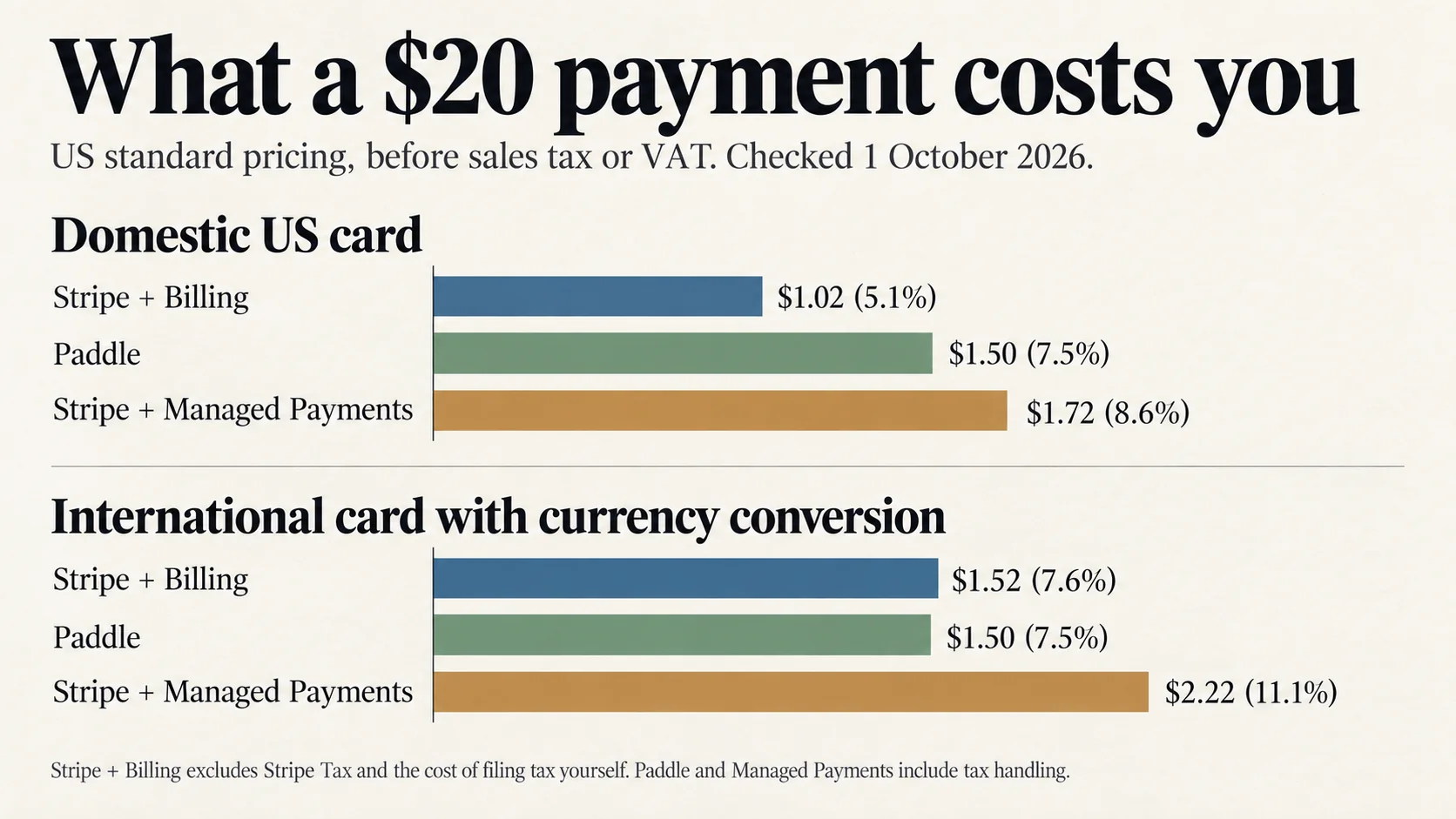
Three patterns come out of those numbers:
- Domestic US cards: Stripe is cheaper at every price. At $20 and $99 the gap is 1.6 to 2.4 percentage points; at $5 it widens to 5.4 points because of Paddle's higher fixed fee.
- International cards with currency conversion: Paddle matches or beats Stripe. Stripe stacks 1.5% and 1% on top of its base fee; Paddle's rate stays flat. At $99, Paddle is almost a full point cheaper, and it also covers the tax. Paddle converts foreign sales into your balance currency, and we could not find a published margin for that conversion. Its API reports the exchange rate on each payout, so check your own statements.
- Low prices punish fixed fees. At $5, Stripe keeps almost 10% and Paddle 15%. If you charge under $10 a month, annual billing is worth considering whichever provider you use.
Annual plans reduce the fixed fee. A $240 annual plan on Paddle costs $12.50 (5.2%) instead of $18.00 across twelve $20 monthly payments. On Stripe with Billing, the same comparison is $8.94 against $12.24. Our guide to annual versus monthly billing covers the other trade-offs.
A monthly bill at $5,000 MRR
Per-payment fees only matter in total. Take an illustrative SaaS at $5,000 MRR: 250 customers paying $20 a month, 60% on US cards and 40% on international cards that need currency conversion.
| Stripe + Billing | Paddle | |
|---|---|---|
| 150 US card payments | $153.00 | $225.00 |
| 100 international payments | $152.00 | $150.00 |
| Payment fees | $305.00 (6.1%) | $375.00 (7.5%) |
| Tax compliance | Your cost: registrations, Stripe Tax fees, filings | Included |
Paddle costs $70 more a month in fees here, or $840 a year. Stripe's saving has to cover everything Paddle does and Stripe does not. If those 100 international customers are EU consumers, you need a VAT registration and quarterly returns. Stripe Tax Basic adds 0.5% on those payments ($10 here), and it calculates tax but does not file it. Stripe's Tax Complete plan, which does include filings, starts at $90 a month on a one-year contract. That entry tier lists 2 registrations and 4 filings a year and 200 transactions a month, with extra fees for non-US registrations and filings.
In this example, the $70 saving is smaller than the entry price of the compliance tool alone. That is the typical small-SaaS result: once you pay for tax compliance, Stripe's lower fee disappears. Stripe's advantage returns as revenue grows, because compliance costs rise more slowly than fees do.
To find your own crossover point, divide your monthly compliance cost by the fee gap. If Stripe saves you 1.4% of revenue, as in the example, and compliance costs you $200 a month in software and accountant time, Stripe becomes cheaper above roughly $14,300 MRR ($200 ÷ 0.014). Use your own price, card mix and compliance quote; a US-only B2B business may have almost no compliance cost at all, while a consumer app with many international customers may have a large one.
Where you are based and what you sell
Before fees matter, check that each option will accept you. The three options have very different eligibility rules.
| Question | Stripe | Paddle | Stripe Managed Payments |
|---|---|---|---|
| Where can your business be based? | 51 countries; India and Indonesia in preview (contact sales) | Anywhere except 28 sanctioned or restricted countries and regions | 37 locations: US, Canada, much of Europe, Australia, Hong Kong, Japan, Singapore |
| What can you sell? | Broad range of goods and services | Software and digital products; no physical goods, and no human services unrelated to software, such as consulting or coaching | Fully automated digital products; no professional services or 1:1 coaching |
| Approval before selling | Standard account verification | Domain review: live HTTPS site with terms, refund policy and privacy policy | Eligibility review, plus an eligible product tax code on every product |
Location often settles the choice for founders outside Stripe's list. If your business is in a country such as Pakistan or Bangladesh, which are not on Stripe's availability page, Paddle is one of the few merchant-of-record options that can accept you. Indian founders should check Stripe's preview status with sales before building on it. Stripe Managed Payments is not available to businesses in either country.
Mixed offers need care. If you sell software plus a done-for-you setup service, the service part falls outside both merchant-of-record options. Many founders bill the service separately, and our guide to productized offers covers how to structure one.
Cash flow, disputes and your customer
When the money arrives
Stripe pays US accounts on a two-business-day rolling schedule, after a first payout that typically takes 7 to 14 days. Paddle creates payouts on the 1st of the month and sends them by the 15th, once your balance passes a $100 minimum. A sale on 2 May reaches your bank around mid-June. Paddle adds no payout fee on local transfers, but international SWIFT transfers cost $/€/£15. If you prepay hosting or AI API costs, that six-week gap matters.
Chargebacks
On Stripe, a dispute costs $15, plus another $15 if you counter it; you get the second fee back if you win. You gather and submit the evidence yourself, or pay for Stripe's AI-assisted responses. Paddle charges $20 per chargeback (40 CAD/AUD). Its dispute system contests disputes automatically and does not accept evidence from sellers, and the fee is not refunded even when Paddle wins. Managed Payments also handles disputes for you and may accept one it expects to lose.
Refunds
Neither provider fully returns fees on refunds. Stripe does not return the original processing fee. Paddle reports a retained fee on refunds and chargebacks in its payout data, and card refunds must be issued within 120 days. Under Managed Payments, customers can request refunds from Link support, and Stripe may refund without your approval if you do not answer a product question within 48 hours.
What your customer sees
With standard Stripe, the checkout, receipt and statement descriptor carry your brand. With Paddle, the statement shows Paddle before your company name, and Paddle handles receipts and invoices. An unfamiliar name on a statement can prompt a dispute, which is why Paddle keeps a public page explaining why Paddle has charged someone and asks sellers to use a recognisable product name in the descriptor. With Managed Payments, receipts and subscription emails come from Link, and custom domains are not supported on its checkout pages.
Building on each option
Stripe standard gives you the most control: hosted Checkout, embedded Elements, Billing for subscriptions and usage pricing, and Connect if you run a marketplace that pays other sellers. It also has the larger ecosystem: SaaS boilerplates, revenue analytics and dunning tools typically support Stripe first.
Paddle Billing has its own API, webhooks and checkout (Paddle.js). It covers standard subscription SaaS well, but check that your boilerplate, revenue analytics and customer portal support Paddle before you commit.
Managed Payments is the most restricted. According to Stripe's documentation, it works only with Checkout and Payment Links. It does not support embedded Elements, Connect, subscriptions created outside Checkout, one-off invoices, or third-party tax tools. If your app already uses hosted Checkout, switching it on is a small change. If you built a custom embedded checkout, it is a rebuild.
Switching later
Neither choice is permanent, but switching is a project. Card details can move between providers through PCI-compliant transfers. Paddle's migration process estimates about two weeks to import payment methods from your old provider, and its subscription migration guide says it will transfer card details to a new provider's PCI-compliant vault within about two weeks if you leave. Stripe documents both importing and exporting card data.
The harder parts are operational: customers see a new name on their statement, webhooks and entitlement logic need rewiring, and tax history is split across two systems. Choose for the next two years of your business, not the next ten.
Which one to pick
| Your situation | Start with | Why |
|---|---|---|
| Selling to individuals in many countries, no accountant | Paddle | VAT on consumer sales can apply from the first sale; Paddle absorbs it for a flat fee |
| Based in a country Stripe does not support | Paddle | Paddle accepts sellers almost everywhere |
| US-based, selling mainly to US businesses | Stripe | Lowest fees; nexus thresholds may keep tax work small for some time |
| Prices under $10 | Stripe, or Paddle custom pricing | The fixed 50¢ fee is a large share of each payment |
| Already on Stripe Checkout, want an MoR, business in an eligible country | Compare Managed Payments with Paddle | Less migration work, but 3.5% on top of Stripe's fees usually costs more than Paddle |
| Marketplace or platform paying other sellers | Stripe Connect | Neither MoR option supports it |
| Software plus consulting, coaching or setup services | Stripe for the services | Both MoR options exclude human services |
| International B2B at $50+ a month | Close call; model both | Paddle's flat fee competes on international cards; B2B reverse charge lightens VAT on Stripe |
Before you decide, run your own numbers:
- List where your customers are. Split your first 50 customers, or your best guess, into domestic, international business and international consumer.
- Check eligibility. Confirm your country and your product type against each option's rules above.
- Price your fees. Use your real price and card mix in the per-payment table. Add Stripe Billing, and add Stripe Tax if you would use it.
- Price compliance. Get a quote from an accountant or check Stripe Tax Complete's tiers against your number of registrations and filings.
- Check your tools. Confirm that your auth, billing portal, analytics and dunning tools support the provider.
- Decide for two years. Choose what fits your next stage, and revisit when revenue or customer mix changes significantly.
If you have not charged anyone yet, do not let this decision delay your first paying customer. Either provider can take money this week. Paddle's review needs a live site with terms, refund and privacy pages, so publish those first. When prices are still changing, our guide to SaaS pricing models is the more important read.
FAQ
Questions people get stuck on
Is Paddle cheaper than Stripe?
Not per payment on domestic cards. A $20 US card payment costs about $1.02 on Stripe with Billing and $1.50 on Paddle. On international cards with currency conversion the two are roughly equal, and at higher prices Paddle can be cheaper. Paddle's fee also covers sales tax and VAT compliance, which you pay for separately with Stripe.
Does Stripe handle sales tax and VAT for me?
Only as a tool, unless you use Managed Payments. Stripe Tax calculates and collects tax (0.5% per transaction where you are registered on the pay-as-you-go plan), and Tax Complete adds registrations and filings from $90 a month. You remain legally responsible. With Stripe Managed Payments, Stripe becomes the merchant of record and takes on tax compliance in more than 80 countries.
What is Stripe Managed Payments?
Stripe's merchant-of-record service for digital products. It adds 3.5% per transaction, calculated on the tax-inclusive amount, on top of standard Stripe processing and Billing fees. It works only with Stripe Checkout and Payment Links, and only for businesses based in 37 supported locations.
Can I use Paddle from India?
India is not on Paddle's list of unsupported countries, so Indian software businesses can apply, subject to Paddle's domain review and acceptable use policy. Stripe lists India in preview, where access goes through its sales team, and Stripe Managed Payments is not available to Indian businesses.
Why does Paddle's name appear on my customer's card statement?
Because Paddle is the merchant of record and legally makes the sale. The statement shows PADDLE.NET* followed by your company name. Stating in your terms and receipts that Paddle is your reseller helps customers recognise the charge and reduces mistaken disputes.
Can I switch from Paddle to Stripe later?
Yes. Paddle says it will transfer customer card details to another provider's PCI-compliant vault on request, typically within two weeks after security checks, and Stripe supports card data imports. Budget time for webhook changes, customer communication and moving tax responsibility back to yourself.