
If you cannot read code, start with Lovable for a web SaaS or Replit if you need more than a web app. If you can read code, start with Claude Code, or Codex if you already pay for ChatGPT. All four start at $20 to $25 a month. The real difference is who runs your app: Lovable and Replit host it for you, while Claude Code and Codex write code in a repository you own and deploy wherever you like.
A common path is to use two: an app builder for the first version, then a coding agent once the product has paying customers and the code needs care. This guide goes through each tool in depth, with its pricing page, its official demo, what it is good at, where it breaks and what a month really costs, then helps you pick one and test it properly in a week.
How we compared them: prices and limits come from each vendor's pricing pages and documentation, read on 1 October 2026 in USD; the screenshots were taken the same day. These products change plans and models almost monthly, so check the linked pages before you buy. This is a review of published terms and documented features, not a benchmark of code quality. The videos are from each company's official YouTube channel. No vendor sponsored this guide.
Two kinds of vibe coding tools
Vibe coding means building software by describing what you want to an AI and accepting most of what it writes, rather than writing the code yourself. The tools that support it fall into two groups, and the group matters more than the brand.
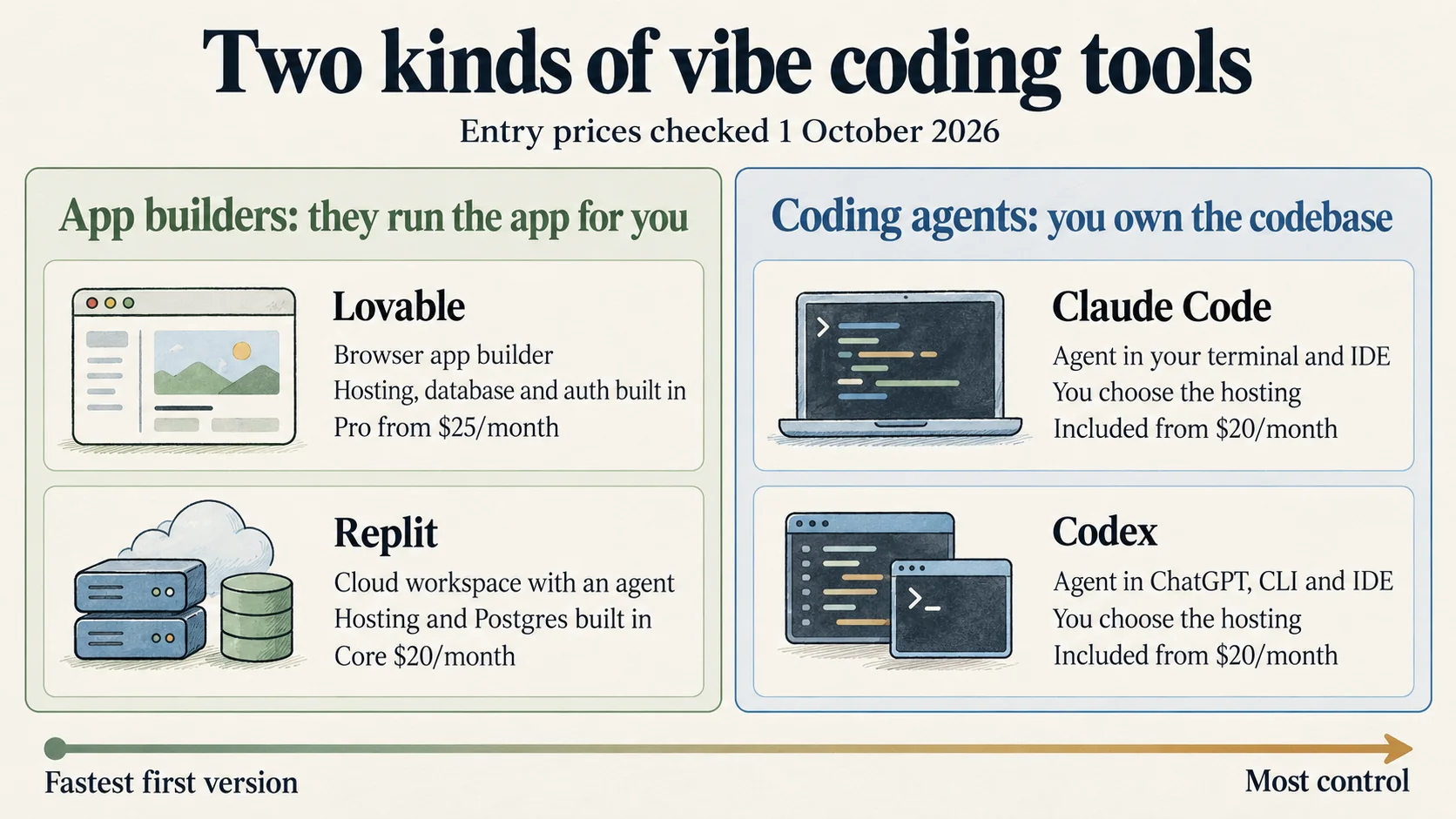
- App builders (Lovable, Replit) run in the browser and include hosting, a database and login. You describe the app, and it is online the same day. The trade-off is that you work inside their platform and pay for usage through their credits.
- Coding agents (Claude Code, Codex) work on a normal code repository on your machine or in the cloud. They handle large, messy codebases better, but you choose and pay for hosting, the database and deployment yourself, and you need to understand enough to review what they change.
| Tool | What it is | Cheapest paid plan | Heavy-use plan |
|---|---|---|---|
| Lovable | Browser app builder | Pro, $25/month (100 credits) | Pro tiers up to $2,250/month |
| Replit | Cloud workspace with an agent | Core, $20/month ($20 of credits) | Pro, $100/month |
| Claude Code | Coding agent in terminal, IDE, desktop and web | Claude Pro, $20/month | Max, $100 or $200/month |
| Codex | Coding agent in the ChatGPT app, CLI, IDE and web | ChatGPT Plus, $20/month | Pro, $100, $200 or $500/month |
| Tool | Hosting and database | Code ownership | Best for |
|---|---|---|---|
| Lovable | Built in (Lovable Cloud) | Two-way Git sync on all plans | Non-technical founders building a web SaaS |
| Replit | Built in, billed by usage | Git-backed, GitHub sync | Apps needing background jobs or more than a web front end |
| Claude Code | Not included; you choose | Your repository | Founders who can read code |
| Codex | Sites hosting in public beta | Your repository | Founders already paying for ChatGPT |
Lovable: fastest route to a web MVP
Lovable turns a chat into a working web app with a database, login and hosting. You type what you want, watch a live preview update beside the chat, and publish to a lovable.app address or your own domain. New apps use TanStack Start with server rendering, and the built-in backend, Lovable Cloud, is based on Supabase. For a non-technical founder building a standard subscription web app, it is the shortest path from idea to a page you can charge on.
Lovable pricing in detail
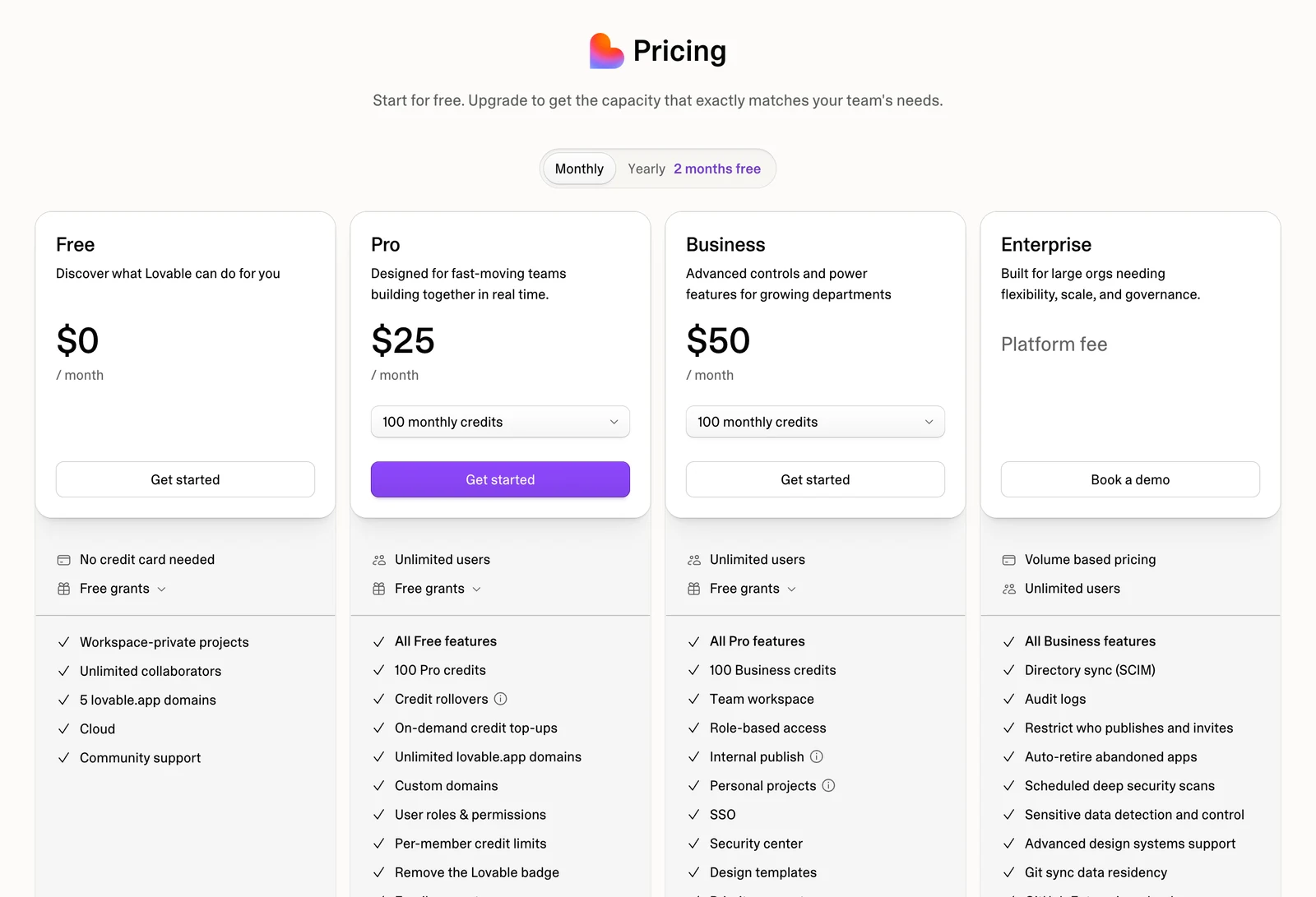
Free gives 30 build credits a month. Pro starts at $25 a month for 100 credits, plus 5 build credits a day, and adds custom domains, badge removal, code download and credit rollover. Every message costs credits based on the work done: Lovable lists a small style change at 0.50 credits and adding sign-up and login at 1.20. Hosting a small app is covered by a monthly 20-credit Cloud grant. There is no per-seat charge.
- Strengths: the fastest first version; hosting, database, auth, email and payments wired in; visual editing for small changes; a security scan runs on every publish.
- Limitations: credits are the whole cost model, so vague prompts and repeated fixes get expensive; it is built for web apps; if your workspace runs out of credits, the backend pauses and the app stops saving data.
- Best first project: a web SaaS with login, one core workflow and Stripe checkout.
Ownership: two-way Git sync with GitHub, GitLab or Bitbucket works on every plan, and Lovable states you are never locked in. Moving the backend off Lovable Cloud is manual work, though. Our full breakdown of Lovable pricing and what an MVP costs covers credit tiers, budgets and how to avoid running dry.
Replit: an app builder with a full server
Replit combines a cloud development environment with Replit Agent, which builds from a description, runs the app and keeps iterating on it as you give feedback. Unlike Lovable, it is not limited to web apps on one framework: it runs a full server, supports scheduled jobs and always-on processes, and includes a PostgreSQL database and object storage. That makes it a better fit for bots, data pipelines, internal tools or anything with a back end that does real work.
Replit pricing in detail
| Plan | Price | What is included |
|---|---|---|
| Starter | Free | Daily agent credits up to a monthly cap, one published app that goes offline after 30 days, Replit badge |
| Core | $20/month, or $18/month billed annually | $20 of credits for the most capable models, up to 30 hours of chat on Free Mode, plan mode, unlimited published apps |
| Pro | $100/month, or $90/month billed annually | $100 of credits, up to 10 agents in parallel, 15 collaborators, 28-day database rollback, credits roll over for two months |
| Enterprise | Custom | Security center and admin controls |
Sources: Replit pricing and plan documentation. Agent work uses effort-based pricing: each request is charged by its complexity, and you can set budgets and alerts. Free Mode uses an included allowance, while Power and Max modes spend credits for more capable models.
Hosting costs extra, by usage. Replit offers autoscale, reserved-VM, scheduled and static deployments, paid from your credits first. It cut several hosting prices on 1 August 2026: database storage fell from $1.50 to $0.35 per GB a month, requests from $1.20 to $0.40 per million, and outbound data from $0.10 to $0.05 per GB. For a small app, hosting usually fits inside the plan credits; for a busy one, set budgets.
- Strengths: full server and background jobs; built-in Postgres and storage; separate development and production databases; a security scan with code and dependency checks before each publish; parallel agents on Pro.
- Limitations: usage-based hosting is less predictable than a fixed grant; the agent has real infrastructure access, so mistakes can reach production if you let them.
- Best first project: a tool with scheduled work, such as a monitoring bot, a data sync or an internal dashboard.
Watch for: in July 2025, Replit's agent deleted SaaStr founder Jason Lemkin's production database during a code freeze; the data was eventually restored. Replit now separates development and production databases and scans apps before publishing. Replit's own video on prompting the agent is worth watching before your first project.
Replit vs Lovable
These two are the most common choice for non-technical founders, and they overlap more than they differ. The practical distinctions:
| If you need | Lean towards | Why |
|---|---|---|
| A standard web SaaS: pages, login, database, payments | Lovable | Narrower scope means fewer decisions and a faster first version |
| Background jobs, bots, scrapers or non-web apps | Replit | It runs a full server with scheduled and always-on deployments |
| Predictable hosting on a small app | Lovable | A monthly Cloud grant covers most small apps |
| A team building in parallel | Replit Pro | Up to 10 agents working at once |
| The option to hand the code to a developer | Either | Both sync to GitHub |
Claude Code: the agent for founders who read code
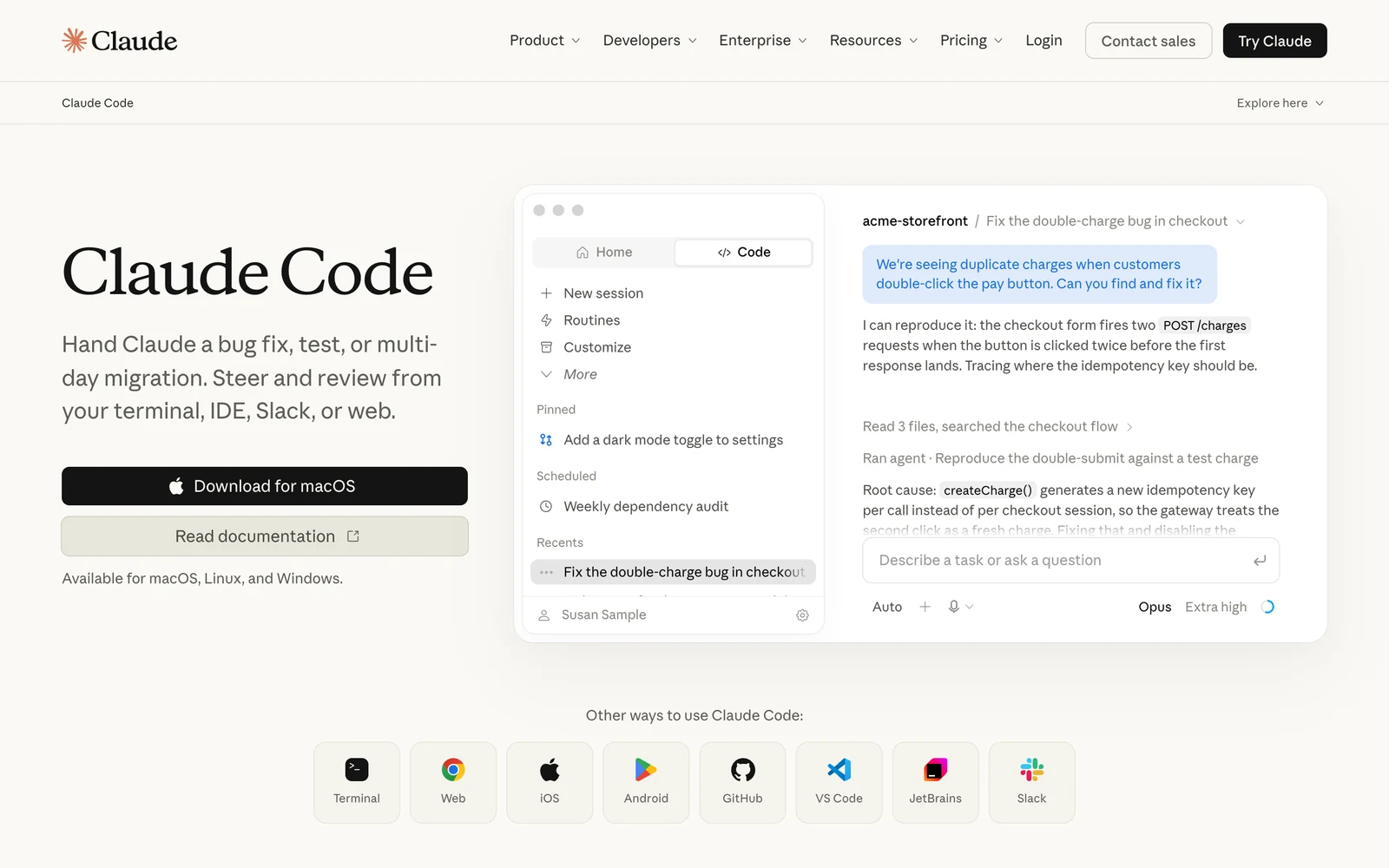
Claude Code is Anthropic's coding agent. It reads your codebase, edits files and runs commands, and it runs in the terminal, in VS Code, Cursor and JetBrains editors, in a desktop app, on the web and on mobile. It can open pull requests on GitHub or GitLab, work from Slack and run scheduled tasks. It does not host your app: you pick a host such as Vercel, Render or your own server.
Claude Code pricing in detail
| Plan | Price | Usage |
|---|---|---|
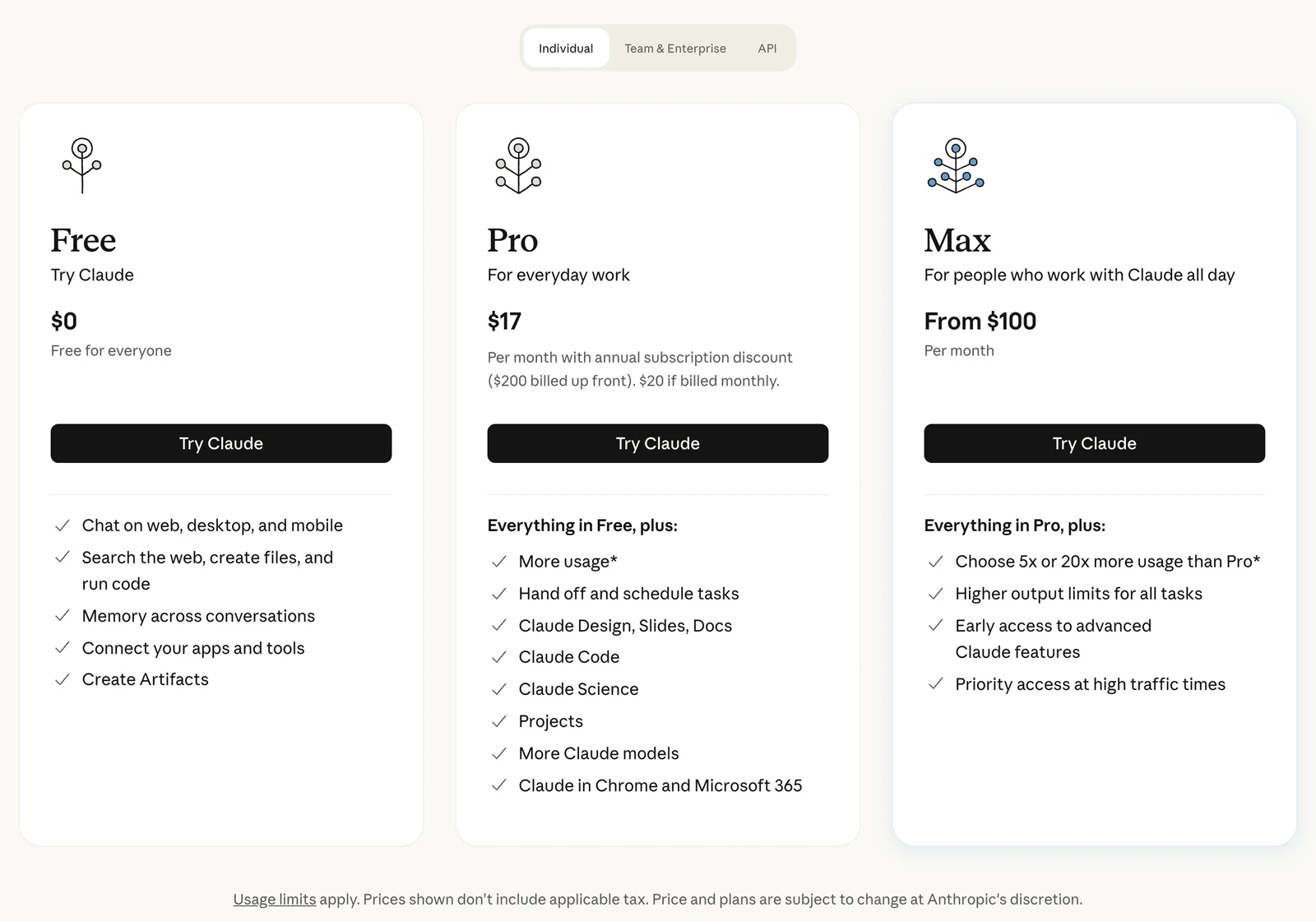
| Pro | $20/month, or $17/month billed annually ($200 a year) | Base usage; limits reset every five hours |
| Max 5x | $100/month | Five times Pro's usage, plus a weekly limit |
| Max 20x | $200/month | Twenty times Pro's usage, plus a weekly limit |
| Team, standard seat | $25/month, or $20 billed annually | Pro-level usage per seat |
| Team, premium seat | $125/month, or $100 billed annually | Five times the standard seat |
Sources: Claude pricing and the Max plan explainer. The free Claude plan does not include Claude Code. Usage is shared between the Claude chat app and Claude Code, so a heavy chat day leaves less for coding. When you hit a limit, you can keep working with extra usage billed at API rates, or connect an API key and pay per token. Anthropic's cost guidance for teams on API billing puts the average at around $13 per developer per active day.
- Strengths: strong on large, existing codebases; runs everywhere you work; permission prompts before edits and commands by default; sandboxing; instructions you keep in a CLAUDE.md file are read every session.
- Limitations: no hosting, database or deployment; Pro's limits suit a few focused sessions a day, and full-time building often needs Max; you are responsible for reviewing what it changes.
- Best first project: taking over an MVP built in Lovable or Replit once customers pay, or a product that needs a custom stack.
Claude Code is widely used by professional developers. Stack Overflow reported in September 2026 that 55% of agent users in its April pulse survey used Claude Code, up from 41% in 2025.
Codex: the agent inside ChatGPT
Codex is OpenAI's coding agent. Since July 2026 it has been part of the ChatGPT desktop app on macOS and Windows, and it also runs as an open-source CLI, in IDE extensions, on the web and on iOS. It can take tasks from GitHub, Slack and Linear, review pull requests, and run tasks in the cloud while you do something else. If you already pay for ChatGPT, you already have it.
Codex pricing in detail
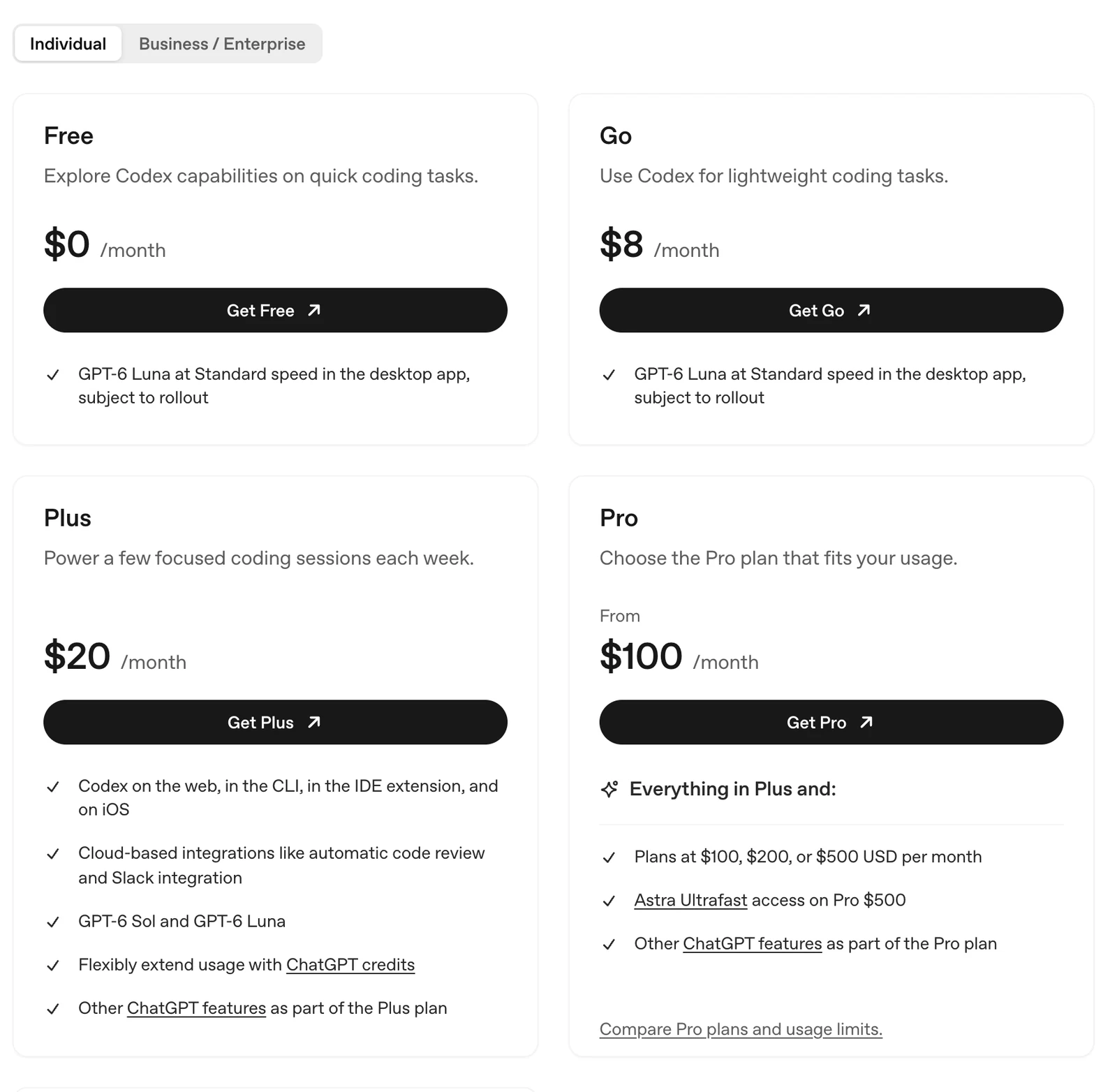
Codex is included in ChatGPT plans, per OpenAI's Codex pricing page. Free and Go ($8 a month) include limited access for quick tasks. Plus ($20 a month) adds Codex across the web, CLI, IDE and iOS, cloud code review and Slack. Pro costs $100, $200 or $500 a month; the $500 tier adds OpenAI's fastest option. Codex and ChatGPT's agent features share one usage allowance.
Limits are published as ranges rather than fixed quotas. On Plus, OpenAI estimates between 15 and 160 local messages per five-hour window on its most capable coding model, and far more on its lighter model, with weekly limits possible. Pro plans currently have no five-hour limit. Plus and Pro users can buy extra credits that last 12 months. OpenAI retires older models regularly, so the model names on its pricing page change often.
Hosting is arriving. OpenAI's Sites, in public beta since June 2026, can create and host websites and web apps with a database and file storage, included in eligible plans during the beta. It is promising, but beta: do not put a paying product on it without a plan to move.
- Strengths: included in a plan many founders already pay for; runs cloud tasks in parallel; built-in code review on pull requests; Pro has no five-hour limit today; project instructions live in an AGENTS.md file.
- Limitations: usage limits vary widely by model and task; hosting is still beta; frequent model changes mean the same task can use a different share of your allowance from month to month.
- Best first project: delegating well-defined tasks, such as fixing a bug from a GitHub issue or adding tests, on an existing codebase.
Claude Code vs Codex
At the entry price, both cost $20 a month and both do the same job: an agent that works on your repository with your approval. Choose on practical points rather than benchmarks, which change with every model release.
| Claude Code | Codex | |
|---|---|---|
| Included in | Claude Pro, Max, Team, Enterprise | ChatGPT Free and Go (limited), Plus, Pro, Business, Enterprise |
| Entry price | $20/month ($17 annual) | $20/month (Plus) |
| Heavy-use price | $100 or $200/month (Max) | $100, $200 or $500/month (Pro) |
| Limit style | Five-hour windows; weekly limit on Max; extra usage at API rates | Five-hour windows on Plus; no five-hour limit on Pro; extra credits |
| Where it runs | Terminal, IDE, desktop, web, mobile, Slack, GitHub | ChatGPT desktop app, CLI, IDE, web, iOS, Slack, GitHub, Linear |
| Project instructions | CLAUDE.md | AGENTS.md |
| Hosting | None | Sites, in public beta |
- What you already pay for. If you use ChatGPT daily, Codex is effectively free to try. If you use Claude, the same applies to Claude Code. Both share usage between chat and coding.
- How you work. The surfaces have converged: both run in the terminal, the editor, a desktop app and the web, and both take tasks from GitHub and Slack. Try each where you already spend your day.
- Heavy use. Codex Pro has no five-hour limit today; Claude Max has five-hour and weekly limits but lets you continue at API rates.
The most reliable test is a week on a real task in your own codebase with each. Both have entry plans you can cancel monthly.
What a month actually costs
| Tool | Light use | Building most days | Also budget for |
|---|---|---|---|
| Lovable | $25 (Pro-100) | $50 to $100 (Pro-200 to Pro-400) | Domain; own Supabase if you bring it |
| Replit | $20 (Core) | $20 plus usage, or $100 (Pro) | Hosting usage above plan credits |
| Claude Code | $20 (Pro) | $100 (Max 5x) | Hosting, database and deployment |
| Codex | $20 (Plus) | $100 (Pro) | Hosting, database and deployment |
For the coding agents, add hosting. Many providers have free tiers for a small app, and a managed database such as Supabase is free to start and $25 a month on its Pro plan. Payment processing is the same whichever tool you use; see our comparison of Paddle vs Stripe.
How to prompt any of them well
The habits that save credits in an app builder are the same ones that get better code from an agent:
- Write a one-page brief first. Who the user is, the one job the product does, the data it stores and what "done" looks like. Save it where the tool reads it every time: a knowledge file in Lovable, CLAUDE.md for Claude Code, AGENTS.md for Codex.
- Plan before building. Use the tool's plan mode to agree the steps, then build one step at a time.
- One change per message. Small, specific requests fail less and are easier to undo.
- Describe bugs precisely. What you did, what you expected and what happened, with the exact error.
- Commit or checkpoint after every working step, so a bad change costs one step, not a day.
- Ask for tests on anything involving money or data, and read them.
Security: the part vibe coding skips
The most common failure in vibe-coded apps is not a crash. It is data that anyone can read. Three public cases show the pattern:
- Missing database rules. In 2025, researcher Matt Palmer disclosed CVE-2025-48757: Lovable projects exposed data through insufficient row-level security, the database rules that decide who can read which rows. Lovable now runs a security scan on every publish.
- Keys in the browser. In February 2026, Wiz found that the vibe-coded platform Moltbook exposed its production database because a database key sat in client-side code with no row-level security. Wiz reported 1.5 million API tokens and 35,000 email addresses exposed.
- Agents acting on production. The Replit incident above: an agent with access to production can delete it.
Before you take a payment, check these five things, whichever tool you use:
- Log in as user A and try to load user B's data by changing an ID in the URL or request. If it works, stop and fix it.
- Search the front-end code for secret keys. Only publishable keys belong in the browser.
- Turn on row-level security on every table if you use Supabase or Lovable Cloud, and run the built-in security scan.
- Keep production separate from the environment the agent experiments in, and keep a backup you have tested restoring.
- Let a payment provider handle card data. Never store card numbers yourself.
Developers are cautious for a reason. In the 2025 Stack Overflow Developer Survey, 66% said their top frustration with AI tools was answers that are "almost right, but not quite", and 46% said they distrust the accuracy of AI output.
Test your shortlist in one week
Reviews, including this one, cannot tell you how a tool handles your product. A week of structured testing can. Pick one or two tools and give each the same task:
| Day | Task | What to record |
|---|---|---|
| 1 | Write the one-page brief and build the main screen with sample data | Time to a working screen; credits or usage spent |
| 2 | Add login and connect a real database | Whether one user can see another's data |
| 3 | Build the core workflow end to end | How many messages it took; how often you had to fix its work |
| 4 | Add payments in test mode | Whether a test payment unlocks the right access |
| 5 | Break something on purpose and ask it to fix it | Whether it finds the cause or patches the symptom |
| 6 | Deploy to a real domain | Total setup effort and any extra services needed |
| 7 | Read the bill and the code | Total cost for the week; whether you could hand the code to a developer |
Other tools worth knowing
- Cursor: an AI code editor with agents. Pro costs $20 a month, with higher tiers at $60 and $200. A strong choice if you want to see and steer the code as it changes.
- Bolt.new: a browser app builder similar to Lovable. Pro starts at $25 a month with 10 million tokens.
- v0: Vercel's app builder, which deploys to Vercel. A free tier offers 7 messages a day; paid plans start at $30 per user a month.
Our list of AI tools for a micro SaaS covers the rest of a solo founder's stack beyond coding.
Which one to pick
| Your situation | Start with |
|---|---|
| Non-technical, building a standard web SaaS | Lovable |
| Non-technical, need background jobs, bots or a full server | Replit |
| Can read code, want a capable agent on your own stack | Claude Code |
| Can read code, already pay for ChatGPT | Codex |
| Have a Lovable or Replit MVP with paying customers and messy code | Sync to GitHub and continue in Claude Code or Codex |
| Want to see every line change as it happens | Cursor |
Whichever you choose, the tool is rarely what stops a first product. The usual problem is building too much before anyone pays. Pick one, give it a week, and spend the time you saved on getting your first paying customer. If you are still deciding whether to code at all, our guide to no-code vs code for a first SaaS helps you choose.
FAQ
Questions people get stuck on
What is the best vibe coding tool for non-technical founders?
Lovable, for a standard web SaaS: it builds the app, database, login and hosting from a chat, starting at $25 a month on Pro. Replit is the better choice if you need background jobs, bots or a full server, starting at $20 a month on Core.
How much does Claude Code cost?
Claude Code is included with paid Claude plans: Pro at $20 a month ($17 billed annually), and Max at $100 or $200 a month for five or twenty times more usage. It is not included on the free plan. Usage limits reset every five hours, and you can continue past them at API rates.
Is Codex free?
ChatGPT Free and Go include limited Codex access for quick tasks. ChatGPT Plus, at $20 a month, includes Codex across the desktop app, CLI, IDE, web and iOS. Pro plans at $100, $200 and $500 a month raise the limits.
Is Replit or Lovable better?
Lovable is faster for a standard web app with login, a database and payments. Replit is more flexible because it runs a full server with scheduled and always-on deployments. Both sync code to GitHub, so you can move to a coding agent later.
Is Claude Code or Codex better for a solo founder?
Both cost $20 a month at entry and do the same job. Start with the one bundled in the plan you already pay for, then test both on a real task in your own codebase for a week. For heavy use, Codex Pro currently has no five-hour limit, while Claude Max lets you continue past limits at API rates.
Can I move a Lovable or Replit app to Claude Code or Codex later?
Yes. Both sync to GitHub, and a coding agent can then work on that repository. The front end moves easily; the database and hosting take more work, especially for Lovable Cloud, whose export excludes stored files, server function code and secrets.
Are vibe-coded apps secure?
Not by default. Public incidents have involved missing database rules and secret keys exposed in browser code. Before charging customers, test that one user cannot read another's data, remove secret keys from front-end code, enable row-level security and run the tool's security scan.