You can build a product this weekend. AI writes the scaffolding. Templates cover auth and billing. That ease is the trap. In 2026 people ship full dashboards, admin panels, and AI agents before anyone has paid a dollar. They call it an MVP. It is a portfolio piece.
An MVP you can charge for is the least product that still earns money for a specific outcome. If the only way to deliver that outcome this month is a spreadsheet and your calendar, that still counts. Payment is the proof. Polish is not.
Pieter Levels said it in June 2026: everyone can build apps with AI. Almost nobody has an audience, money for ads, or a free way to get attention. A few days later he wrote about indie meetups full of people building AI factories with no money and no traffic. They polish the system first and tell themselves sales starts when the factory is done. That order is backwards.
What an MVP you can charge for actually is
Write this sentence and keep it on the desk: "I charge [price] so [who] can get [outcome] without [pain]." If you cannot fill those blanks, you do not have an MVP yet. You have a stack of features looking for a buyer.
The product is whatever delivers that outcome. It can be software. It can be a Notion template you run for them. It can be a weekly report you assemble by hand. It can be a form that emails you and a call where you do the work. The buyer should get the result. You should get paid. Everything else waits.
- One buyer you can name (a job title, a trade, a room they already sit in)
- One painful job they already spend time or money on
- One outcome you can finish in days, not months
- A price written where they can see it
- A path to pay and a path to start
If a feature does not sit on that path, cut it from version one. You can always add it after someone pays.
Why 2026 makes overbuilding worse
Building used to cost months and money. That friction forced some focus. Now a solo builder can generate screens, copy, and boilerplate in a day. The cost of another feature fell. The cost of a wrong product did not. You still burn weeks on the wrong buyer. You just burn them with prettier tools.
Cheap building also fills the feed. Lookalike SaaS. Same landing page. Same "AI-powered" headline. Levels’s point is simple: shipping is no longer scarce. Attention is. So people hide in the editor and build the factory, because that feels like progress and does not require asking a stranger for money.
You are not in a build contest. Sell the thin outcome before you add another screen. Here is what four months of extra screens bought one founder this year.
Four months of product, zero customers
In July 2026, Jack Builds wrote on Indie Hackers after four months of solo building. He coded the features. He polished the landing page. He set up onboarding. Launch day: zero paying customers, not one signup. He had never talked to a potential customer before he shipped.
Indie Hackers · u/Jack Builds
I built a SaaS that got 0 paying customers at launchJuly 2026. Four months of building. Launch day: zero paying customers. He never talked to a buyer before he shipped.
His first ten customers came later, when he looked for people already searching, not from feature 47 on the roadmap. Four months of polish did not make the launch safer. If that much code can still produce zero, the first version can be thinner than you think. It can even be you doing the job by hand.
Manual is allowed. Manual is often better
Paul Graham’s "Do Things that Don't Scale" still describes the first version of almost every real company. Recruit users one by one. Delight them by hand. Sometimes you are the software. Stripe’s early "instant" merchant accounts were founders doing the boring setup behind the scenes. Wufoo sent handwritten notes. Airbnb founders went door to door.
If you can find someone with a problem that needs solving and you can solve it manually, go ahead and do that for as long as you can, and then gradually automate the bottlenecks.
That line is from 2013. It is more useful now, not less. Automation is cheap to start and easy to point at the wrong step. If you code the pipeline before you have sold the outcome, you are guessing which steps matter. If you run the pipeline yourself for a few buyers, you know which buttons to build.
Manual does not mean sloppy. It means you own the gap between what the product does and what the customer needed. Answer the same day. Fix the file yourself. Join the call. That attentiveness is part of the product when you are small. Big companies cannot do it. You can.
Pick one buyer and one painful job
Start with a person, not a market size. A freelance bookkeeper who drowns in receipt photos. A clinic manager who copies the same form every Monday. A founder who still builds invoices in a spreadsheet. You need someone you can message this week, not a TAM slide.
Talk about their last time, not your idea. What did they try? What broke? What did it cost in time or money? Steal their words for the page. If three people describe the same mess in different rooms, you have a job worth selling. If every conversation is a different fantasy feature list, you do not have a product yet.
Narrow is how you ship. "For any small business" forces you to build forever. "For dentists who hate their recall list" lets you ship a thin path and charge for it.
Write the offer before you write the stack
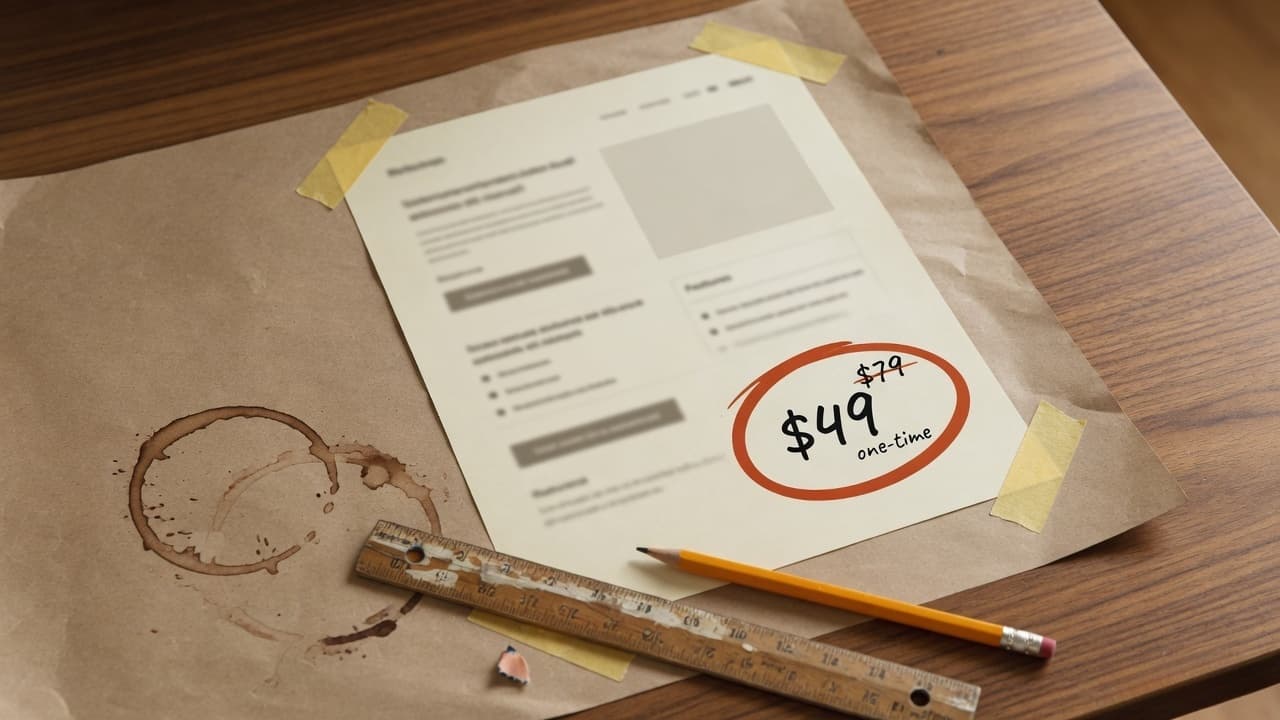
One page. No marketing poetry. Who it is for, what you remove, what they get, what it costs, how they start. Put the price on the page. If you hide the price, people treat the product as optional.
I help [job title] get [outcome] in [timeframe] for [price]. You send me [inputs]. I return [deliverable]. If it is not useful, you say so in the first week and we stop.
Charge a number you can say out loud without flinching. Too low and they treat the work like a toy. Too high for a first thin offer and you stall before you learn. Pick a price next to what they already spend on the mess (a tool, a contractor, an hour of their week). Then say it. The first buyers will tell you if you are wrong.
Ship the thin version (or do the job yourself)
Build only the path that produces the paid outcome. Login if you must protect data. A form if you need inputs. A place to show the result. Skip the settings screen, the team invites, the public API, the admin theme switcher. Those are week-six problems for a product that has week-one revenue.
If code is slower than delivery, skip code. Examples that still count as an MVP:
- A Typeform or email intake, you process the work, you send the result as a PDF or link
- A shared spreadsheet you update for them every week
- A calendar booking plus a fixed deliverable after the call
- A single-page app that only does the one job, with you handling edge cases by hand
Tell the buyer what is human and what is automatic. Pretending you have a full platform when you are the platform does not help. Graham’s Viaweb story still applies: they built stores for merchants by hand and learned the product from the work. When you are ready to automate, use no-code versus code for a first SaaS to choose the implementation path.
Charge on day one of delivery
Do not wait for a launch day. Do not hide the price behind "book a demo" if you already know the package. Send a payment link when they agree. Invoice the same afternoon. Cash, transfer, UPI, card: whatever moves money where you live.
Payment changes the conversation. Free users give you feature requests. Paying users give you constraints. They tell you what is broken because it costs them. That feedback is the product roadmap. Everything before the first charge is guesswork dressed as research.
If this takes [pain] off your plate, it is [price]. I can start this week. Send [the one thing I need] and I will have [deliverable] to you by [day]. Want to do that?
When they pay, deliver fast and stay close. Ask what almost made them say no. Ask what they still do by hand around your tool. Those answers become version two. Not your imagination.
Automate only after the pain repeats
Keep a short log for each paid job: steps you took, minutes each step cost, where you copied data, where you fixed a mess by hand. After a few paid runs, circle the step that ate the most time and that every customer needed. Automate that step. Leave the rare edge cases manual.
This is how you stop polishing a system nobody paid for. You are not building a platform for imaginary scale. You are removing your own bottleneck after someone already paid. Code becomes a way to sell the same outcome more times, not a way to feel productive before the first sale.
A two-week plan
- Day 1. Write the offer sentence. Name 20 people who might buy. Put a price on a one-page site or a plain document with a pay link.
- Days 2 to 4. Talk to five of them about the last time the problem hit. Do not pitch until you hear the same pain twice.
- Days 5 to 7. Build the thinnest path that delivers the outcome, or set up the manual process. No extra features.
- Days 8 to 10. Send personal notes with the price and the outcome. Book short calls. Ask for the money on the call.
- Days 11 to 14. Deliver for anyone who pays. Log every manual step. Fix only what blocked delivery. Count paid customers, not commits.
If you have zero payments after real conversations, change the offer or the buyer. Do not open a new repo. If you have one or two, protect delivery and ask each buyer who else has the same problem. Shipping and selling are different jobs. When you are picking which tools to buy for each job, see the 10 best AI tools for a micro SaaS. When the product is chargeable, go get your first 10 paying customers without ads.
What to stop building
- A second user role before the first user paid
- Integrations nobody asked for on a paid call
- A free tier that delays the first charge. Charge if you can deliver.
- A public launch plan with no names on a list
- An AI agent that does twelve jobs when you have not sold one
- Dark mode, changelog, and referral program week one
- Rewriting the stack instead of delivering the outcome
How you know the MVP works
Someone pays. They use the result. They come back or they introduce a peer. That is the whole scoreboard. Stars on a launch page do not count. Your own pride in the architecture does not count.
If people say it is interesting but will not pay, the outcome is not sharp enough or the buyer does not feel the pain this month. If they pay and still need you on every step, you have a service with a product shell. That is fine. Productize the parts that repeat. Keep the rest human until volume forces you.
Then you have something real
A chargeable MVP is not a smaller SaaS. It is proof that a specific person will give you money for a specific result. In 2026 building is cheap. The hard part is stopping early and asking for the money. Manual work is not a failure. It is how you learn what deserves code.
Indiecity is for one person or a team under twenty. When the offer works and the name is yours, put it on the map. If you learned something hard about charging for a thin first version, send us the story. You can join Indiecity while you run the two weeks. That gives you people to talk to. It does not replace the first payment.
Until then, write the offer, put a price on it, and deliver the smallest thing someone will pay for.
FAQ
Questions people get stuck on
Is a landing page an MVP?
Only if someone can pay. A page with a waitlist is a flyer. A page with a price, a way to pay, and a clear next step is an offer. The product behind it can still be thin or manual. The payment is what makes it real.
Is it cheating if I do the work by hand?
No. Paul Graham wrote it in 2013 and it still holds: when you only have a few users, you can do by hand what you plan to automate later. You launch faster, and you learn what is worth coding. Fake software that solves a real problem beats real software that solves none.
How polished does the product need to look?
Polished enough that the buyer trusts you with money and data. Not polished enough to delay the first charge. A clean page, a working path for the one job, and a human who answers email will beat a perfect design system with zero revenue.
What if competitors already have every feature?
You are not racing their roadmap. You are selling one painful job to a buyer you can name. Their full suite is often slow, expensive, or aimed at a different person. Your edge is focus, speed of reply, and a price that matches a single outcome.
Should I use AI or no-code for the first version?
Use whatever gets a paying outcome in the fewest days. In 2026 that often means AI writing the boring parts and you owning the offer. No-code vs code is a speed choice, not a purity test. Tools are not the product. The product is the outcome someone paid for.
When should I automate the manual parts?
After the same step hurts you more than once a week, and after at least a few people have paid for it. Automate the bottleneck you can describe from memory. Do not automate a workflow nobody bought.
What if nobody pays for the thin version?
That is useful. Either the problem is not painful enough, the buyer is wrong, or the outcome is unclear. Change the offer or the buyer. Do not add three features and hope. Payment is the test, not your roadmap.
Should I offer a free trial?
Only if you need them to feel the result before they pay, and only if the trial ends in a hard ask. Free forever teaches you about free users. A short paid start (one week, one project, one seat) teaches you about buyers.
Do I need a company and a brand first?
You need a way for money to move and a way to deliver. A payment link and an email address are enough for week one. Set up a company when a bank or a lawyer makes you. Do not wait for a logo before you charge.