A bootstrapped startup on customer money pays its bills with cash from people who bought. The payment has cleared. The server, the contractor, and your living costs come out of that. A round you plan to close later is not the plan.
Indiecity is for one person or a team under twenty. How to start a SaaS with no money is the cheap stack. Bootstrap vs raising if you want to stay under twenty is the company you are deciding to run. This page is how you run the month after you choose customers.
What customer money means
Customer money is cash in the account from a buyer. A free user is not it. A trial is not it. A forecast is not it. An investor note that says you will be profitable is not it.
Jason Fried wrote the rule on the 37signals site: make more money than you spend. He also writes that nothing is easier than spending other people's money. When the cash is yours, you notice the extra seat and the extra tool, because a customer already paid for them.
You simply make more money than you spend.
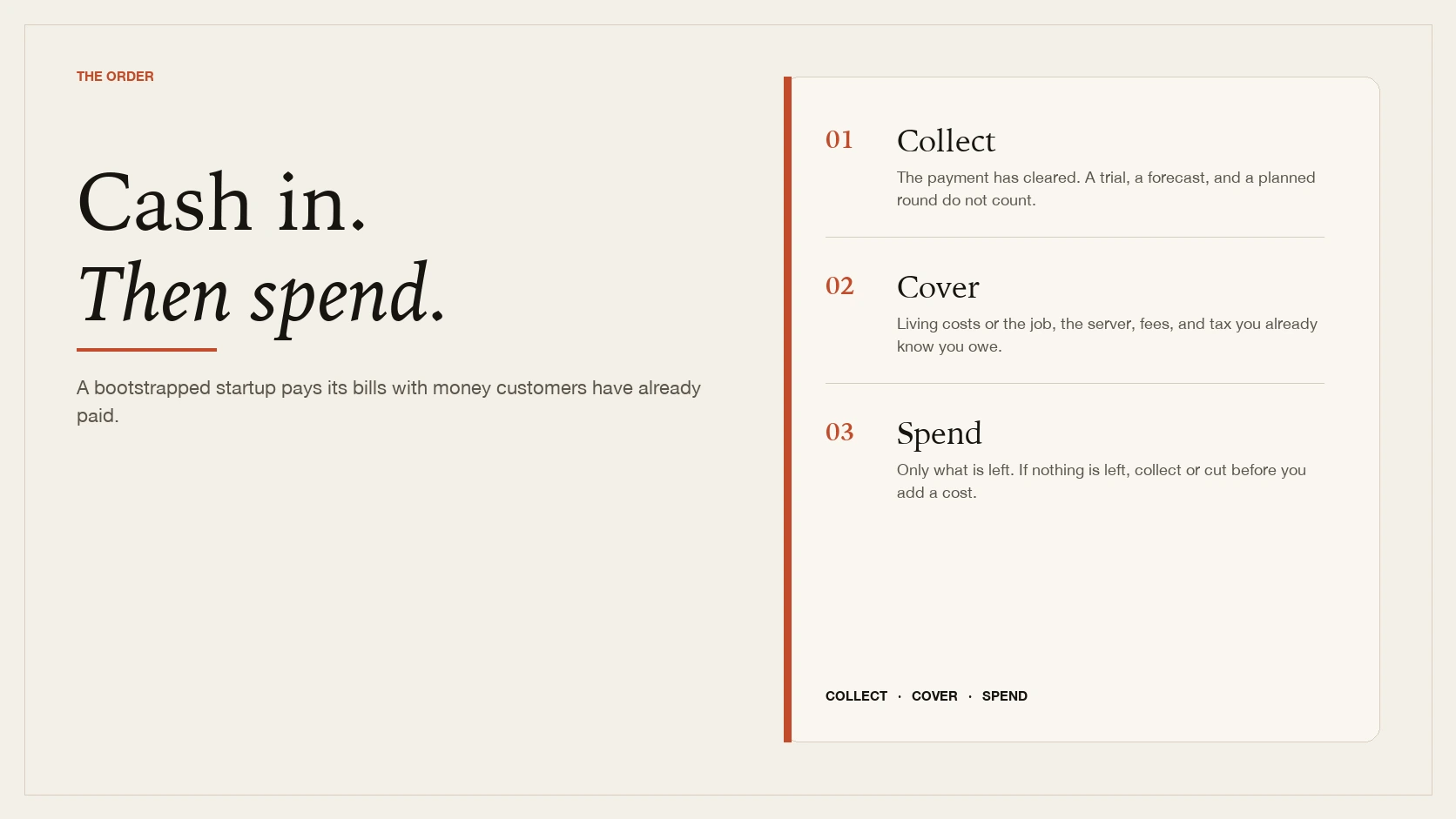
On that same page he treats profit as a promise to customers. In the funding freeze of 2008 and 2009, he writes, profits insulated the company from jittery investors, and customers kept paying for Basecamp. He points at 2022 as well: public markets fell, and 37signals had no stock price to explain to the people who use the product. You do not need a company of their size. You need the order. Collect. Cover the bills. Spend what is left.
Check whether you are default alive
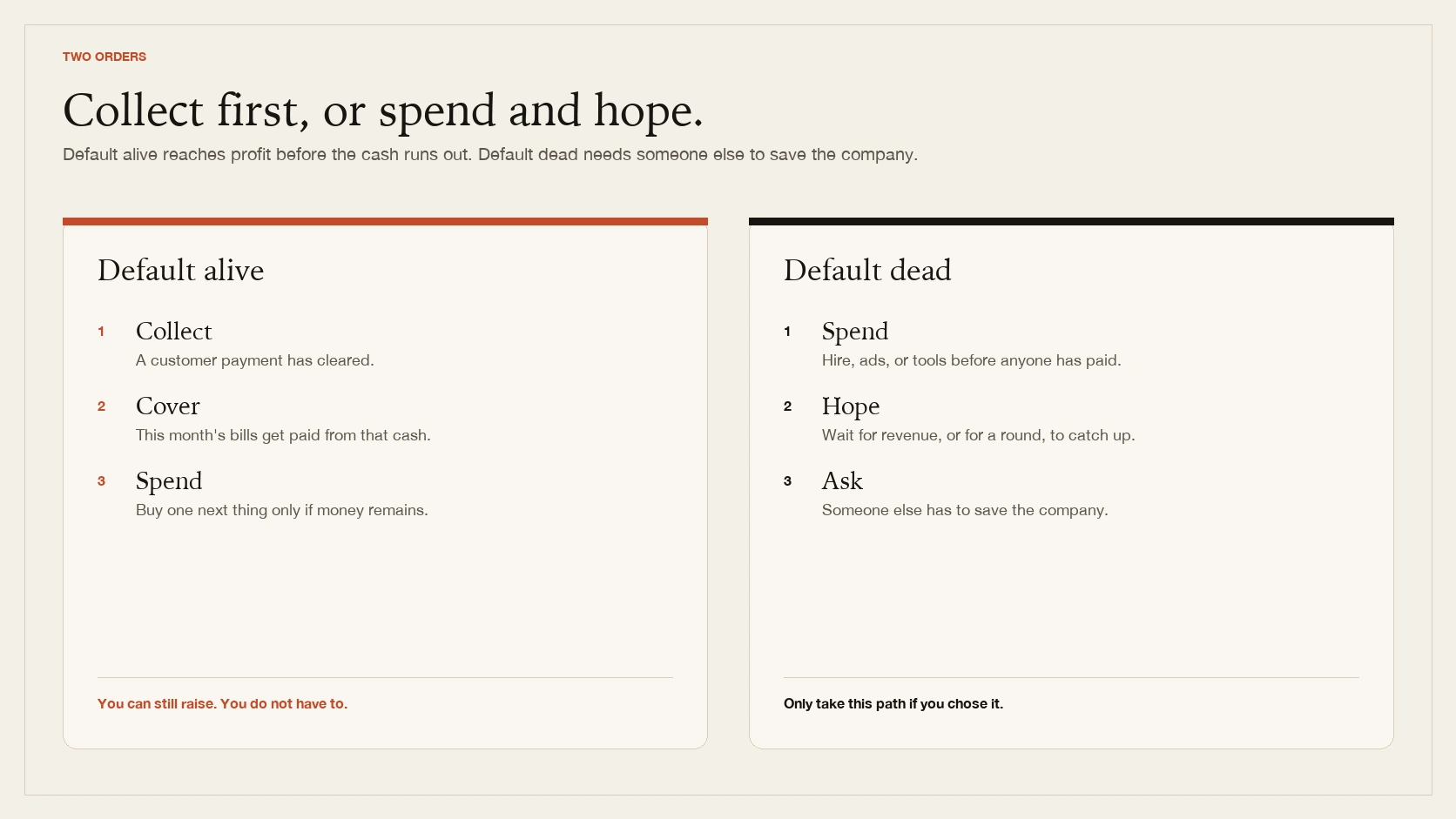
Paul Graham's test is the one to write on the sheet. Keep expenses flat. Let revenue grow only as fast as it has over the last several months. Do you reach profitability before the cash you have runs out? If yes, you are default alive. If no, you are default dead, and you are counting on someone else to save the company.
With no investors, the cash you have is savings plus what customers have paid. If that pile is small, do not wait for revenue to speed up on its own. Cut a cost or collect an invoice until this month covers itself.
Graham says hiring too fast is by far the biggest killer of startups that raise money. Founders tell themselves they need people in order to grow. You can make the same mistake with no round at all. You hire against savings, the savings end, and there is nobody to call. Hire when collected cash already covers the person. When to hire your first employee is that decision. Staying under twenty is the same rule after the first hire.
Cover living costs first
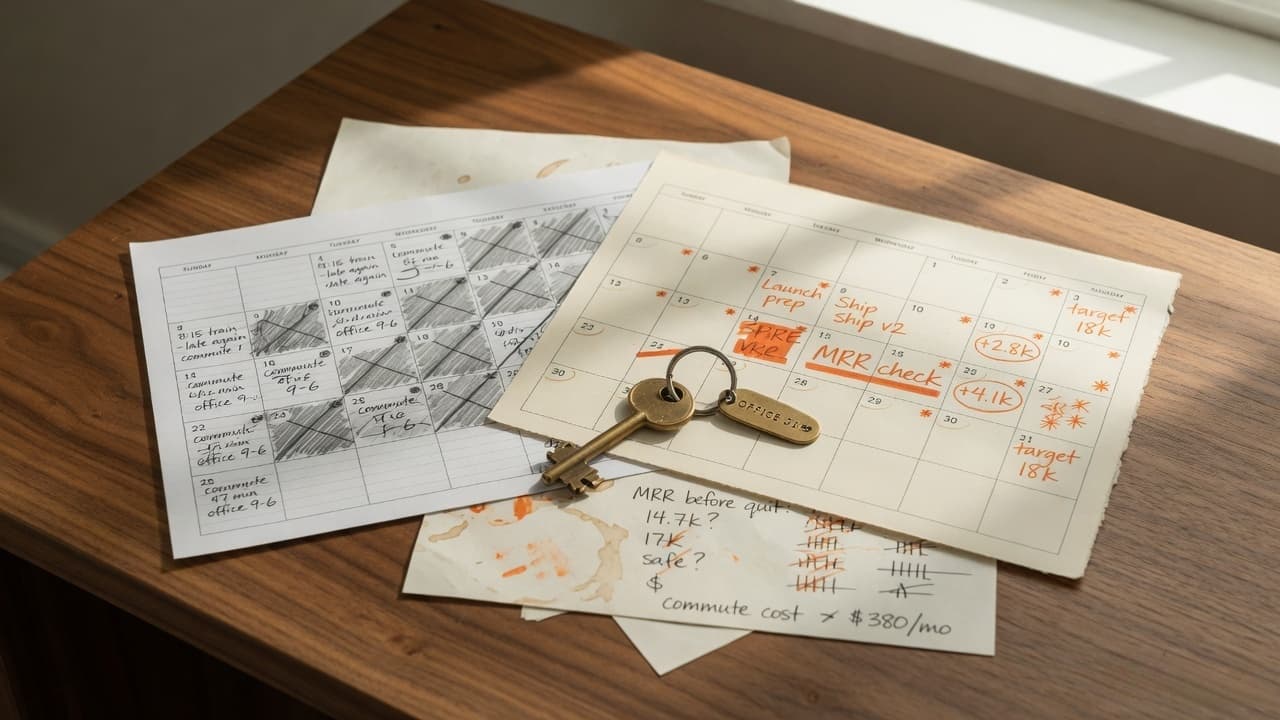
The first cost is your living expenses, or the job that still pays them. In July 2009 Graham defined ramen profitable as a startup that makes just enough to pay the founders' living expenses. His picture was two young founders and $3,000 a month. That figure is from 2009. It is not your target. Your target is rent, food, tax, and health costs you can list. How much MRR you need before quitting is the household version. Do not quit because a round number showed up in a thread.
The milestone is still the right one. Once living costs are covered, you do not have to raise in order to survive. Graham is clear that you can still raise. You do not have to do it now. He writes that during a fundraise he thought about investors in the shower, which meant he was not thinking about the work. Customer money lets you pick the month, or skip the round.
Once you're ramen profitable this painful choice goes away. You can still raise money, but you don't have to do it now.
Read the limit he put on the phrase. Ramen profitable is not a vow that you will never take investment. It is not proof the company has won. In that essay he still wanted the company to get huge. If you want a smaller company, use the milestone anyway. Survival no longer depends on an investor.
He names a trap that still catches product people. It is easy to make a modest amount from consulting and call the result a startup. A little custom work at the start is normal. He says so. A calendar that is only custom work is a services firm. If you want a product, give the client work an end date. First, get the cash before you do the work.
Get the customer's cash before you spend
John Mullins told The Irish Times in September 2014 what customer-funded companies share. Get the customer's money early, and pay your suppliers later than you got paid. That is timing. It is not a license to skip a bill you already owe. He looked for a sixth way and did not find one. Too much cash, too early, he said, can turn founders stupid. Little money, he said, makes you sharper. You adapt the plan to what customers will pay for, instead of defending the plan you already sold.
| Model | What the customer does | Use it when |
|---|---|---|
| Matchmaker | Pays a fee for an introduction. You do not own the thing sold. | The product is the introduction. Repeat jobs can leak: once the two sides know each other, they can skip you. |
| Pay in advance | Pays a deposit or the full price before you deliver. | The pain is sharp enough that they will pay before the work is finished. |
| Subscription | Pays on a schedule for something you keep delivering. | You bill before the month of work, or they pay for several months at once. |
| Scarcity | Pays now because the quantity or the window is actually limited. | You cannot mint another copy tonight. A fake countdown is not this model. |
| Service to product | Pays for custom work you later sell as one offer. | A few buyers are funding a product the next buyer can purchase. |
Three of the five are the ones a small software company can run this month. Subscription is the product you mean to sell, and the cash is early only if you collect before you do the month of work. Pay in advance is a deposit, a setup fee, or a year paid up front. Mullins says people pay early when the pain is pressing, including for a solution that is not finished. Service to product is a client check that pays for a thing you will sell again. His historical case is Microsoft moving from contract operating systems to software in a box. Your version is smaller. Turn the client work into a productized offer.
Leave the other two alone unless they describe the product. A matchmaker lives on the introduction. Mullins's worry there is repeat work. A dog owner and a sitter who have met can book the next visit directly. He worried less about a one-off trip, because the next booking is often a different place, not the same pair meeting again. Scarcity needs a real limit. Software you can copy does not have one.
Ask for the year
Monthly cash covers a monthly bill. A year paid at once covers a year of bills with one payment. That is a subscription collected before you do the work. Annual vs monthly pricing is the full setup: one price grid, a yearly option, and the ask after someone already gets value.
Do not invent a percent off. Patrick McKenzie's public default for a low-touch SaaS is the monthly price, with one month free if the customer pays for the year. He sent that offer to people who already used Appointment Reminder. The note is short: what the product does, one month free to switch, a link, and permission to ignore it. His notes put the company-side reason first. Cash arrives sooner.
You have been on the monthly plan since March. If you switch to annual this week, you pay for twelve months and I take one month off that bill. Same product. I will send the invoice today. If you want to stay monthly, do nothing.
Send it to people who already pay. A stranger does not owe you a year. An annual payment is cash you can use, and it is also a year of product you still owe. Do not spend all twelve months in the first week.
Put an end date on client work
Client cash can fund the build. It can also become the company. Mullins shows how a buyer's check can pay for the product. Graham shows how that same check can fill the calendar until the product never ships.
Write the end date before you start. This deposit pays for a version the next customer can buy. If the client wants a private build you will never sell again, price it as services and do not count it as the product. The first paying customer can be someone you already know. The second and the third should be buying the same thing.
I can start on Monday if the deposit clears this week. I will not book the days until it does. The rest is due when I deliver. This version is the one I will sell to the next customer. If you need a private build I will not resell, say so now and I will price that as a separate job.
Do not start on a promise. A promise is not customer money. Cleared cash is.
Let one product pay for the next
Rob Walling wrote the stair step in March 2015 so the first product could fund the later one. Step one is a small product and one way people find it. Step two is enough revenue from that work that you can leave the job. Step three is a standalone product people pay for every month, built with the time and cash the earlier steps earned. He writes that subscription revenue takes a long time to become substantial, which is why a big subscription product is a poor first bet.
If you already have the larger product, use the order inside it. The customers you have pay for the next bet. Do not use those customers as a reason to go raise. Use the payments to fund the next bet. A second product, or a deeper first one, still has to pass the same Monday test as the first.
Spend only what you have collected
Write four lines every Monday. Use the bank and the invoices. If a line is a guess, leave it blank and go get the number.
| Line | What you write | Leave it blank when |
|---|---|---|
| Collected | Payments that cleared in the last 30 days. | You are forecasting. |
| Due | Server, tools, contractors, fees, and your draw if the product pays you, all due in the next 30 days. | It is a tool you might buy later. |
| Tax hold | The amount you already know you owe, from your accountant or your last return. | You are inventing a percentage. |
| Left | Collected, plus cash in the account that is yours to spend, minus Due and Tax hold. | You cannot point at the number in the bank. |
If Left is below zero, you are spending money you do not have. Cancel or delay a bill, or collect an invoice, before you add anything. An annual payment can sit in Collected. Remember you still owe the rest of the year of product, so do not hire a year of salary out of one invoice.
What Left may buy, in this order:
- Nothing, when Left is below zero.
- The server, the payment fees, and the tools the current customers need.
- Your minimum draw, if you have already quit and this product is supposed to pay you.
- One new cost that helps the next customer pay: a contractor for a stuck job, or a tool you will use this month.
Price the product so a small number of customers can carry those lines. A low price plus a long list of tools is how Left goes negative while new signups still look fine.
Run it for two weeks before you change the company. In week one, fill the four lines. If Left is below zero, cut one bill or send one invoice before Friday. In week two, send the annual note to people who already pay monthly. If custom work is on the table, send the deposit note and do not start until it clears.
Then do the same Monday again. Keep the sheet current. That sheet is how you run a bootstrapped startup on customer money.
When you still need outside money
Some work cannot be covered by early customers. Graham wrote that ramen profitability was not feasible for most biotech, because the cost is more than living expenses. If you must buy inventory, lab time, or a regulated build before anyone can pay, and buyers will not pay in advance, customer money is not there yet.
Mullins still leaves room for a raise later. He says the time for venture capital is after customer traction shows you are onto something. Raising before that, he told The Irish Times, uses up the months you should spend changing a plan that is probably wrong. You already promised investors the first plan, so you keep spending on it.
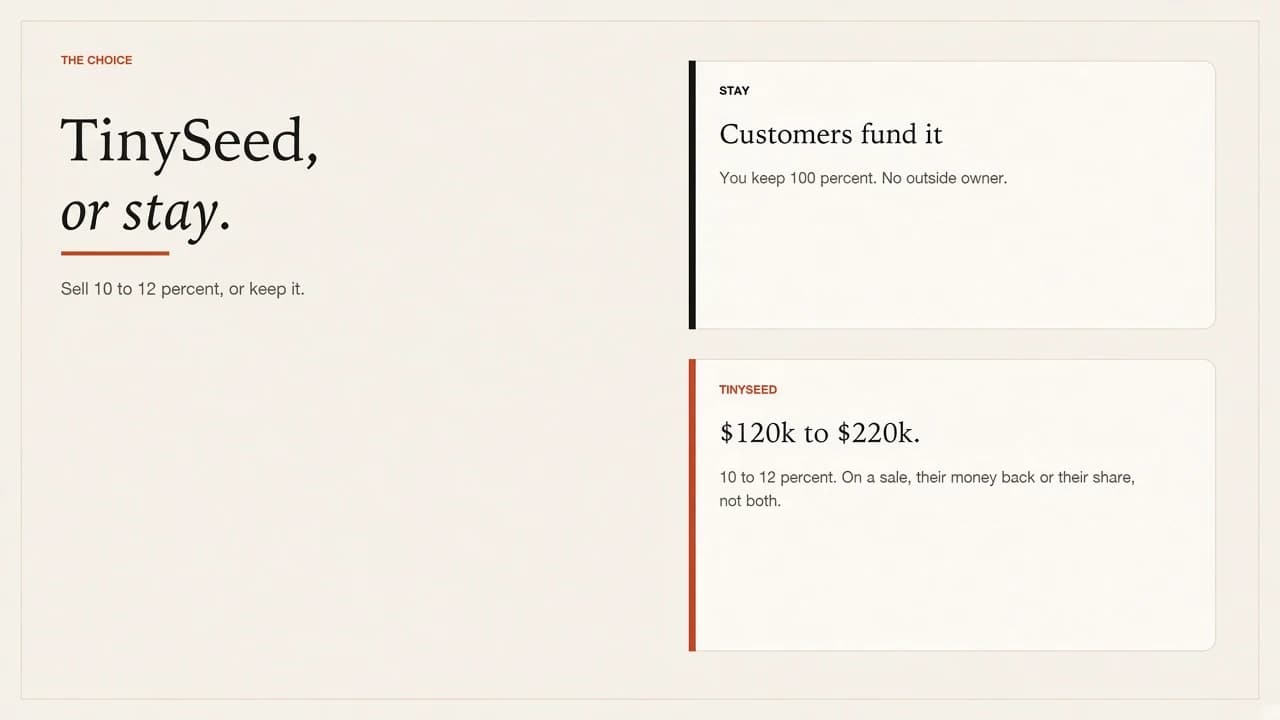
If you want a company that must get huge before revenue, and you accept being default dead until a round lands, write that down and choose it on purpose. If the outside check is TinySeed rather than a venture fund, read it against staying bootstrapped. If you want this company, stay on the sheet. Collect. Cover the bills. Spend what is left.
FAQ
Questions people get stuck on
What does it mean to run a startup on customer money?
The bills are paid by people who bought. Cash has cleared. A free user, a trial, a forecast, and a round you hope to close do not count. Jason Fried's rule at 37signals is the short version: make more money than you spend.
Do I have to be profitable before anyone pays?
No. Profit is what is left after customers have paid and the bills are covered. Before the first payment you have a project. Get the first paying customer, then run this rule on real cash.
Can I use savings while I get those customers?
Yes, if you can name the amount and the date it runs out. Paul Graham's default-alive test asks whether you reach profitability before that cash is gone, with expenses flat and growth no better than it has been. If the date arrives first, cut a bill or collect an invoice. Do not hire against the savings and call it a plan.
Is $3,000 a month the goal?
No. In Ramen Profitable (July 2009) Graham used $3,000 a month as a picture of two young founders covering living costs. Your number is your rent, food, tax, and health costs. How much MRR you need before quitting is that math. Do not quit on a number you saw in a post.
Should I ask customers to pay annually?
After they already get value, yes. Annual payment is how a subscription gets you cash before the year of work. Annual vs monthly pricing keeps one price grid. Patrick McKenzie's public default is the same monthly price, with one month free if they pay for the year. Do not invent a percent off.
Does client work count as customer money?
The cash counts. The calendar can trap you. A deposit can fund a product you will sell again. A week that is only custom work is a services firm. Turn the work into one offer, and put an end date on the private jobs.
What if a funded competitor spends more than I can?
They can buy ads and people. They also take on a company that must keep raising or cut hard when the round slows. Your job is a customer who pays and stays, at a price that covers the month. Price it so a small group can carry it.
When should I raise money?
When customer cash cannot fund the work, and you want that other company on purpose. John Mullins told The Irish Times the time for venture capital is after customers have shown you are onto something. Bootstrap vs raising is the choice. Raising so you can put off selling leaves you default dead until someone else says yes.