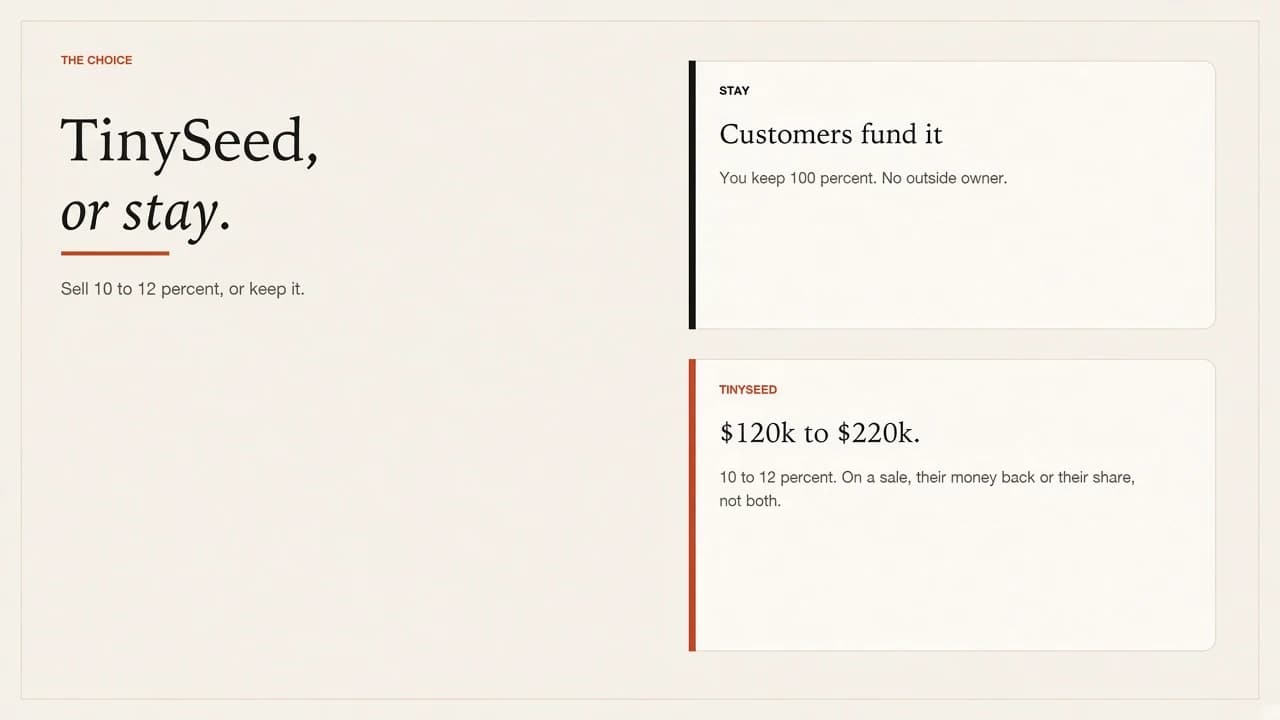
TinySeed pays $120,000 to $220,000 for 10 to 12 percent of a B2B SaaS company. If you stay bootstrapped, you keep that percent, and customers fund the company. The figures in this guide are from TinySeed's site in October 2026. A venture fund is a separate decision. Read that on the bootstrap vs raising page.
What TinySeed is
TinySeed is a one-year remote accelerator for 15 to 20 SaaS companies. The program page says there is no homework, no test, and no demo day. You do not have to raise a round when the year ends. Their about page says you can raise later, or choose not to.
Rob Walling and Einar Vollset started it for MicroConf founders. Their about page says those founders only had two choices, bootstrap or venture. TinySeed has since funded more than 180 SaaS companies across four continents. That number is how many they funded. It is not how many succeeded.
Applications open again in February 2027. That date is on the program page. Before then, get paying customers, or decide you will not apply. If you might apply, read the fee next. The $120,000 to $220,000 range is not the full offer.
The check, the percent, and the fee
The published terms are $120,000 to $220,000 for 10 to 12 percent of the company. You can take the money as salary, or spend it on marketing, design, contractors, or anything else that grows the business. The page says the funding is there so a founder can go full-time, hire, or start a paid growth test they could not pay for before.
There is a program fee of $7,450 per founder. It is charged only if you are accepted, and it comes out of the investment. TinySeed says they increase the offer so the fee is covered. Their example says a $150,000 offer with two founders becomes $159,900. That increase is $9,900. Two times $7,450 is $14,900. The example and the fee do not match. If you get an offer, use the offer. Do not use the example.
Ten to twelve percent is the price of the check and the year. Stay bootstrapped and that slice stays yours. Take TinySeed and it does not come back, even if you never sell.
They do not take a cut of revenue
This is the part people mix up with a loan. TinySeed does not take a percentage of revenue. They do not start a profit share on a date they pick. The 2026 application notes say the same thing as the program FAQ: you decide when to issue a dividend, and they share that dividend in proportion to ownership.
The threshold is your pay. You can raise your own compensation up to $250,000 a year. Money you take out above that is a dividend. If they own 10 percent, they receive 10 percent of the dividend, not 10 percent of sales. You can reinvest every dollar of profit for as long as you like. They say they will wait.
TinySeed does not take revenue or profit from your company, only dividends that you decide to pull out at timing that works for the business.
They chose equity over a revenue share on purpose. A fixed share, they write, can start while you still need the cash to grow, and then it behaves like a bill you cannot pause. A dividend waits until you choose to take money out. The risk sits with them until that day. The equity is theirs from the day you sign.
Read the sale clause before you decide
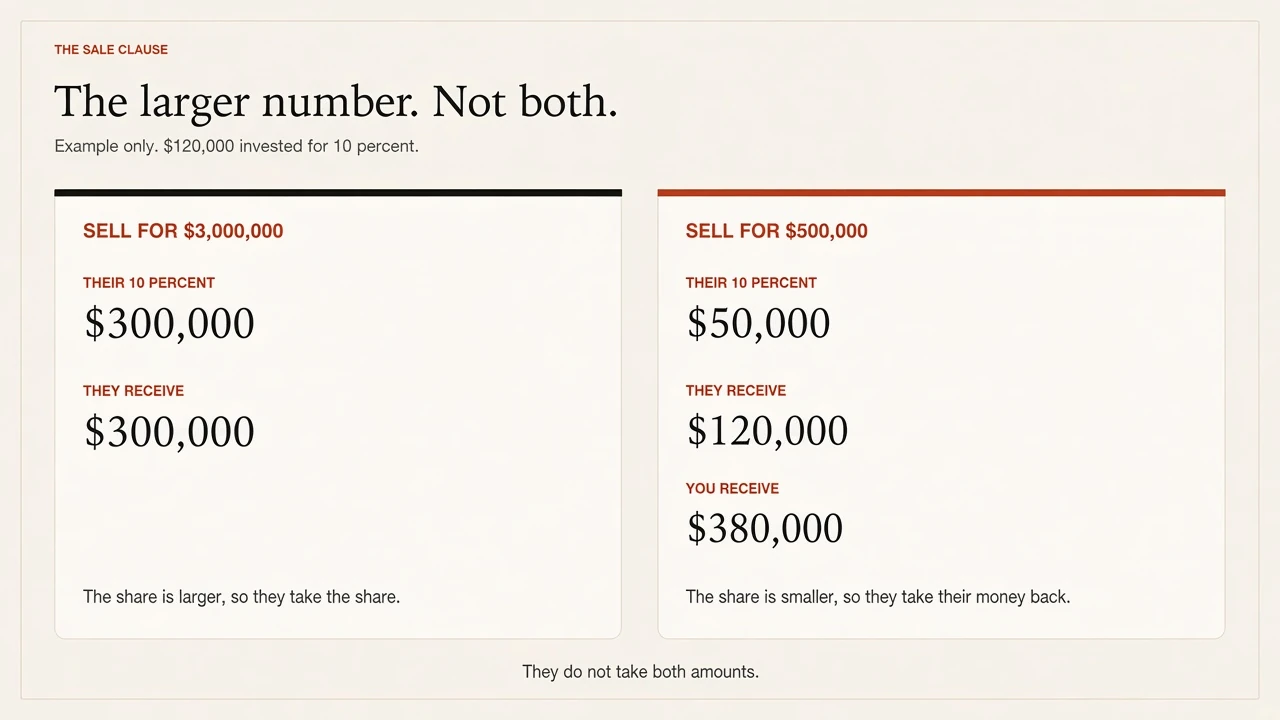
If the company sells, TinySeed receives the greater of two amounts. One is their investment back, minus dividends already paid to them. The other is their ownership share of the sale. Whichever number is larger, they take that.
Here is the clause with round numbers inside their published range. It is an example of the math, not a prediction.
| If you sell for | Their 10 percent | What the clause pays them |
|---|---|---|
| $3,000,000 | $300,000 | $300,000, because the share is larger |
| $500,000 | $50,000 | $120,000 back, because the share is smaller |
On a large sale, this is ordinary ownership. On a small sale, they take their investment back instead of the smaller share. They do not take both. In the $500,000 row, they receive $120,000 and you receive the other $380,000. Dividends already paid to them reduce that $120,000. If you want the percent to apply even when it pays them less than the investment, stay bootstrapped.
If you later raise venture capital, their shares convert into the same class as the new investors. They also keep a right to put more money in at that round's price. Staying independent is allowed. Raising later is allowed. A forced next round is not part of the published terms.
Who they will fund
They fund B2B SaaS. The 2026 application preview says product-market fit usually shows up as revenue, that more than $500 in monthly recurring revenue is a strong sign, and that applications with no revenue will be denied. They will still look at a later application if the company has grown. A blank application now does not help you.
The program page uses a higher bar as a rule of thumb: a couple of thousand dollars a month is a sign the team has pushed the business forward. They also say they have no top limit, and they have funded companies already doing seven figures a year. Zero is a no. $500 a month is what the application calls a strong sign. A couple of thousand a month is what the program page treats as evidence.
They want companies that can become a 7- or 8-figure business. A 2026 post on their thesis says $5 million to $10 million in annual recurring revenue is a huge win, not a consolation prize. The about page puts the same idea in one line.
To most venture capitalists $10M in annual revenue is an abject failure. To us, it's a great business.
That line is the difference from a venture fund. It is also why a company you plan to keep tiny does not match the application. They will back a business a venture fund would call small. They are still looking for a path to seven figures.
They currently invest only in a US C-corp, preferably Delaware. You can apply from India, the UK, Canada, Australia, or anywhere else they list, and from an LLC or an unincorporated project, if you will reincorporate when they make an offer. They say they have funded companies in those countries and across Europe, South America, and the Middle East. Batch calls are at 11am US Eastern. They record them for people who cannot attend live.
They also say they do not share the usual bias against one founder. On the program page they write that most of the successful SaaS companies they know, in the $1 million to $30 million range, were started by someone working alone. That is their experience, not a census.
Stay bootstrapped
Stay when the TinySeed terms solve a problem you do not have.
- You have no revenue. They will deny the application. Get the first paying customer before you write to them.
- Customers already cover the month, and you cannot name what $120,000 would buy. Run the company on that money. If the money has no named cost, you only get a smaller share of the same company.
- You will not give up 10 to 12 percent, or you will not accept them taking their investment back on a small sale instead of the smaller share.
- You will not become a Delaware C-corp.
- Your real plan is a company that stays well below a 7-figure business. Keeping the team under twenty can still be a large SaaS. Capping it on purpose, far below their bar, is a reason to stay out.
- You cannot do 11am US Eastern, or you will not travel to the kickoff and to MicroConf. The ticket and the hotel are in the program fee. The flight is yours.
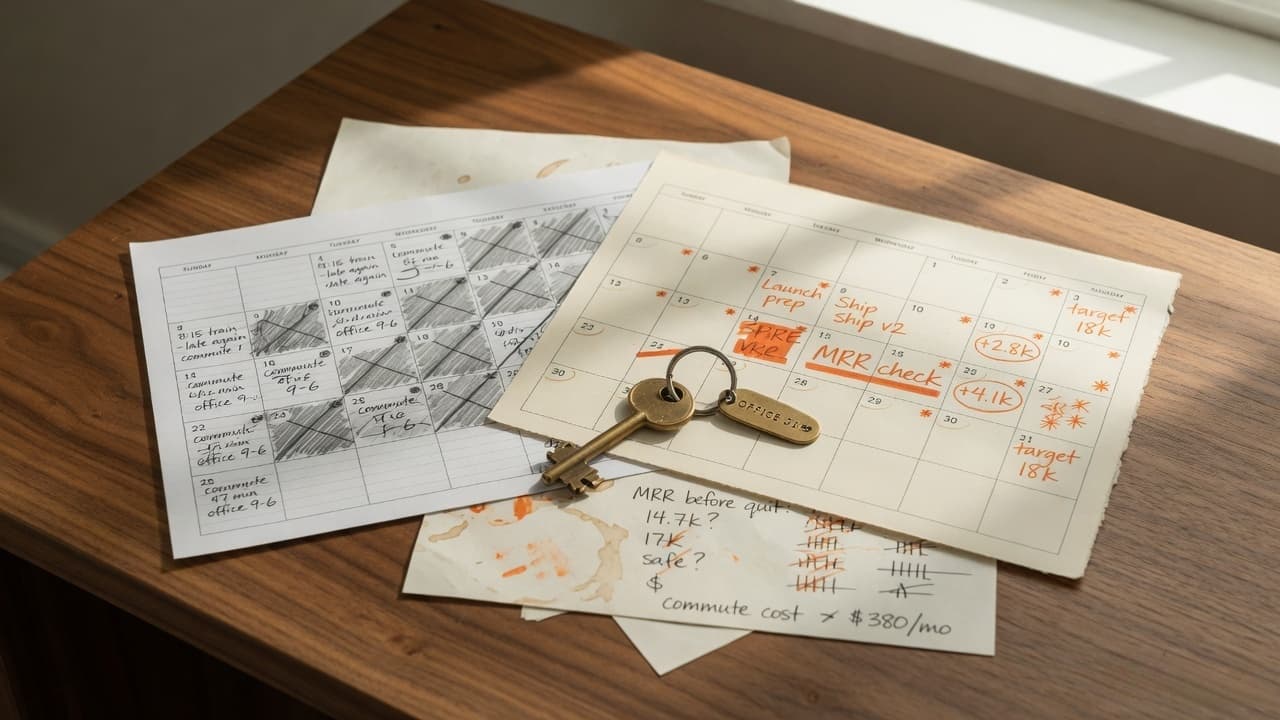
Quitting a job is not, by itself, a reason to take the check. How much MRR you need before quitting is a household question. If customer revenue can reach that number, you do not need to sell a slice to leave the job. If it cannot, and the check is the bridge, write that down as the job of the money. Then decide.
Take TinySeed
Take it when three things are true at once. You have revenue they will not bounce. You have written down what the money will pay for. You will actually use the year.
Name one of the three costs on their page: going full-time, a hire the current revenue cannot carry, or a paid growth test. Write the number next to it. If the cost is vague, the check is vague.
The year is a short call schedule and a long list of people you can ask. They try to keep calls to about four hours a month: two sessions with the whole batch, two with a smaller mastermind. The first three months follow a playbook on pricing, hiring, funnels, and lead generation. After that, mentors come in. The page names people such as Jason Fried and DHH, and says founders can ask for an introduction when a mentor has time. They also report that more than half the companies they fund say they applied for the coaching and the community, not only the cash. That is their count of what applicants told them.
Their own FAQ answers the person who does not need the money: the mentorship can still be worth it, because one conversation can stop a bad hire or a wasted pricing change. You pay for that access with 10 to 12 percent. The year ends. The percent does not. If you will not show up to the calls or the two trips, you bought a network you will not use.
After the year, they say alumni keep the Slack, the mentor requests, and the events. The equity does not expire when the calendar does.
Fill this in before February
Do this before you open the application. If your honest answer is in the stay column, do not apply.
| Question | Stay bootstrapped | TinySeed can fit |
|---|---|---|
| Do you have recurring revenue? | No. They deny those applications. | Yes. You can state MRR, churn, and how a customer arrives. |
| What does the check buy in the next twelve months? | You cannot name a cost. | Full-time pay, one hire, or one paid test, with a number. |
| Can you live with 10 to 12 percent, and with their sale clause? | No. | Yes. You have read the greater-of line. |
| How big is the company you are willing to build? | You plan to stay far below a 7-figure business. | Seven figures is the aim, even if a unicorn is not. |
| Will you reincorporate, make the calls, and take the two trips? | No. | Yes. |
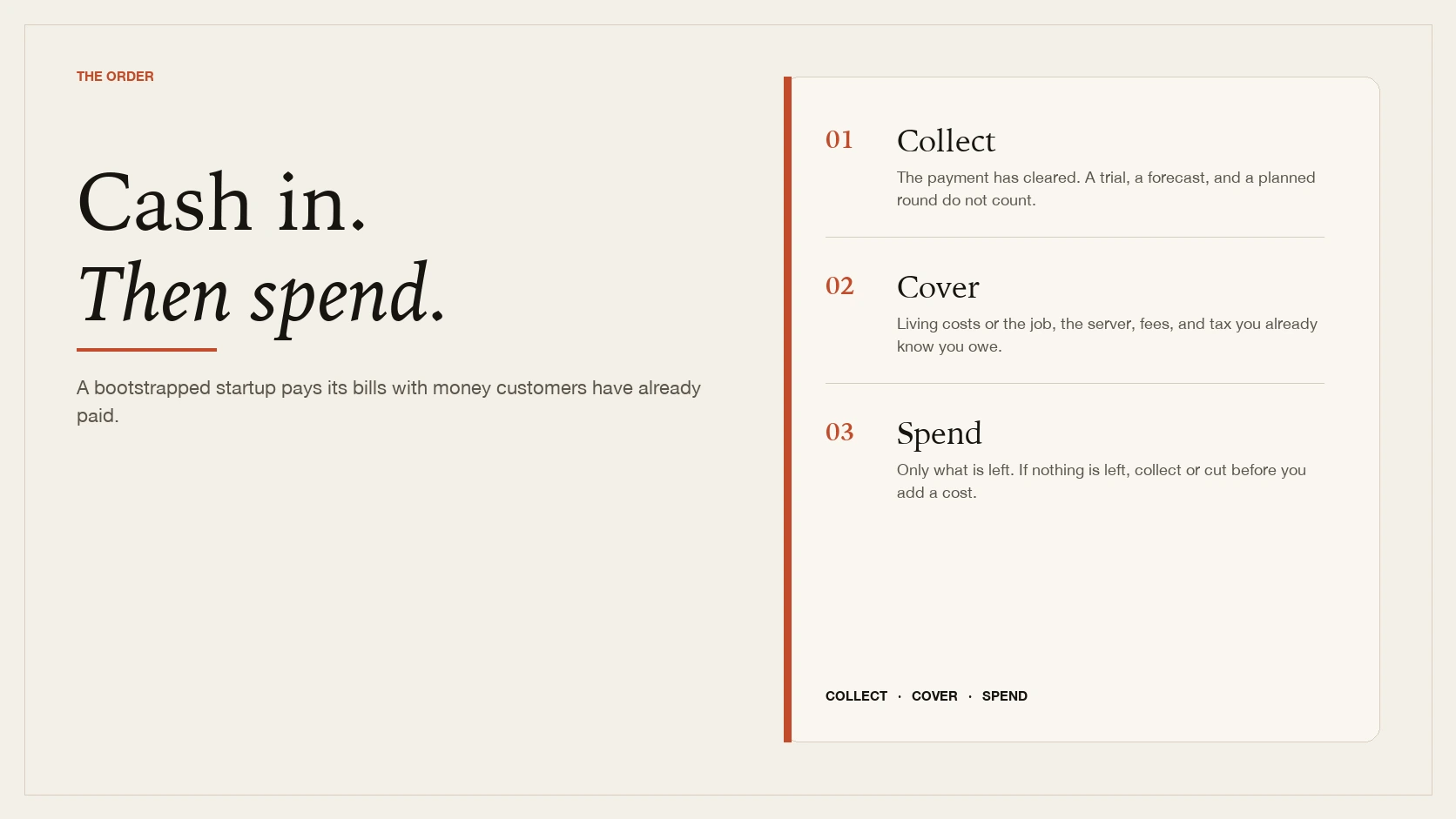
If you stay, go run the month: collect from customers, cover the bills, spend what is left. If you take TinySeed, the check joins that month. It does not replace it. They still do not pay your costs out of a revenue share, and they still do not require a round next year. Customers still pay the bills. The percent is what you paid for the cash and the year.
FAQ
Questions people get stuck on
Is TinySeed the same as raising venture capital?
No. Their about page says they exist because capital-efficient founders only had bootstrap or venture, and that $10 million in annual revenue is a failure to most VCs and a great business to them. They do not require a demo day or a next round. They still take equity. Bootstrap vs raising is the wider choice. This page is only TinySeed against staying fully bootstrapped.
How much does TinySeed invest, and for how much of the company?
Their program page says $120,000 to $220,000 for 10 to 12 percent. There is also a program fee of $7,450 per founder, taken from the investment. They say they increase the offer to cover that fee. The example on the page does not match $7,450 times two founders, so read the offer letter.
Do they take a percentage of revenue?
No. They do not take a revenue share or a profit share on a schedule. You can pay yourself up to $250,000 a year. Money you take out above that is a dividend, split by ownership. You choose when a dividend happens. Until then, they wait.
Can I apply with no revenue?
They will deny it. The 2026 application preview says applications from companies without revenue will be denied, and that more than $500 in monthly recurring revenue is a strong sign. Get a paying customer first. How to get your first paying SaaS customer is that job.
Do I have to move, or become a US company?
You do not have to relocate. The program is remote. They currently invest only in a US C-corp, preferably Delaware. You can apply from another country or another entity if you will reincorporate. Calls are at 11am US Eastern, and they record them. They ask you to attend a kickoff retreat and a MicroConf. You pay your own travel.
What if I want a small company, not a $10 million one?
Stay bootstrapped. They fund SaaS companies they believe can become a 7- or 8-figure business. A company you intend to cap far below that is a different plan. How to keep a SaaS under 20 people is how to run the company you already have. They will not fund that plan.
When can I apply?
Their program page says applications open again in February 2027. Use the months before that to get revenue, name what the check would buy, and read the sale clause. Do not send an application with a blank MRR field.
Should I join if I do not need the money?
Their FAQ says yes, because of the mentors and the batch. You still give up 10 to 12 percent. If customers already fund the month and you will not use the cohort, stay bootstrapped. Run the company on that customer money.