In 2026 you can ship a SaaS in a weekend. The hard part is saying what it is so a real person will pay. Most founders open with features, a category label, or three empty words. The buyer still does not know if it is for them. Pieter Levels wrote about indie meetups full of AI factories: dashboards and pages, almost no money or traffic. A sentence that does not name a buyer and a price is how you join that pile.
You need one sentence. Not a manifesto. Not a homepage rewrite. One sentence you can say on a call, drop in a DM, and put above the fold. Indiecity is for one person or a team under twenty. This is the line you use before you buy ads.
The job of the sentence
The sentence has three jobs. Name who pays. Name the pain you remove in their words. Name the price. If any piece is missing, people nod and leave. They do not buy.
April Dunford defines positioning as how your product is a leader at delivering something a well-defined set of customers cares a lot about. Your one sentence is that idea in plain speech. Well-defined is not “SMBs.” Well-defined is a person you could email this afternoon.
Do not lead with easy, fast, or free
Open almost any AI-built landing page in 2026 and you will see the same trio: easy, fast, free. Or secure. Or simple. Those words feel safe because they sound universal. They are empty.
It says easy, fast, free. Those three words should never, ever, ever be the headlines or sub-headlines on your page. Do you know why? They don't mean anything.
That line is from 2012. It still holds. Easy for you is not easy for an ops lead. Free attracts people who want free. Fast is a claim every competitor makes. Ramit’s fix was not a thesaurus. It was research: the words people already use for the mess. When you use their words, they hear the problem, not a slogan.
Patrick said the same thing another way. Buyers do not wake up with a WordPress problem. They wake up with a business problem. Your sentence talks about the business problem, not your stack.
Who: a person who can pay
Who is not a market size slide. Who is a job title, a company shape, or a situation you can point at. “Founders” is still too wide if you mean “solo founders who already invoice clients.” “Agencies” is too wide if you mean “three-person design studios that bill monthly retainers.”
If you cannot name five people who match the who, you do not have a who yet. Sit in the rooms where that job complains. Copy their words. Do not invent a persona deck. Write a list of names.
- Bad who: “teams,” “anyone who wants productivity,” “SMBs,” “creators”
- Better who: “freelance bookkeepers with 15+ monthly clients”
- Better who: “clinic office managers who still schedule by phone and spreadsheet”
- Better who: “Shopify store owners who hate their returns process”
Pain: their words, not your feature
Pain is what they already tried to fix. It is the workaround, the late night, the tool they cancel every year and rebuy. It is not “lacks visibility” or “needs a single source of truth.” Those are consultant phrases. Builders hear the real version on a call if they stop pitching.
Rob Fitzpatrick’s Mom Test is still the clean rule: talk about their life, ask what they did last time the problem hit, and do not pitch while you are learning. Customer interviews when you have zero users are how you collect those phrases. They become the middle of your sentence.
If you have not had those talks yet, read public ones. One-star reviews. “Anyone know a tool for X” threads. Job posts that describe a broken process. Copy the verbs. Your product name can wait.
Price belongs in the sentence
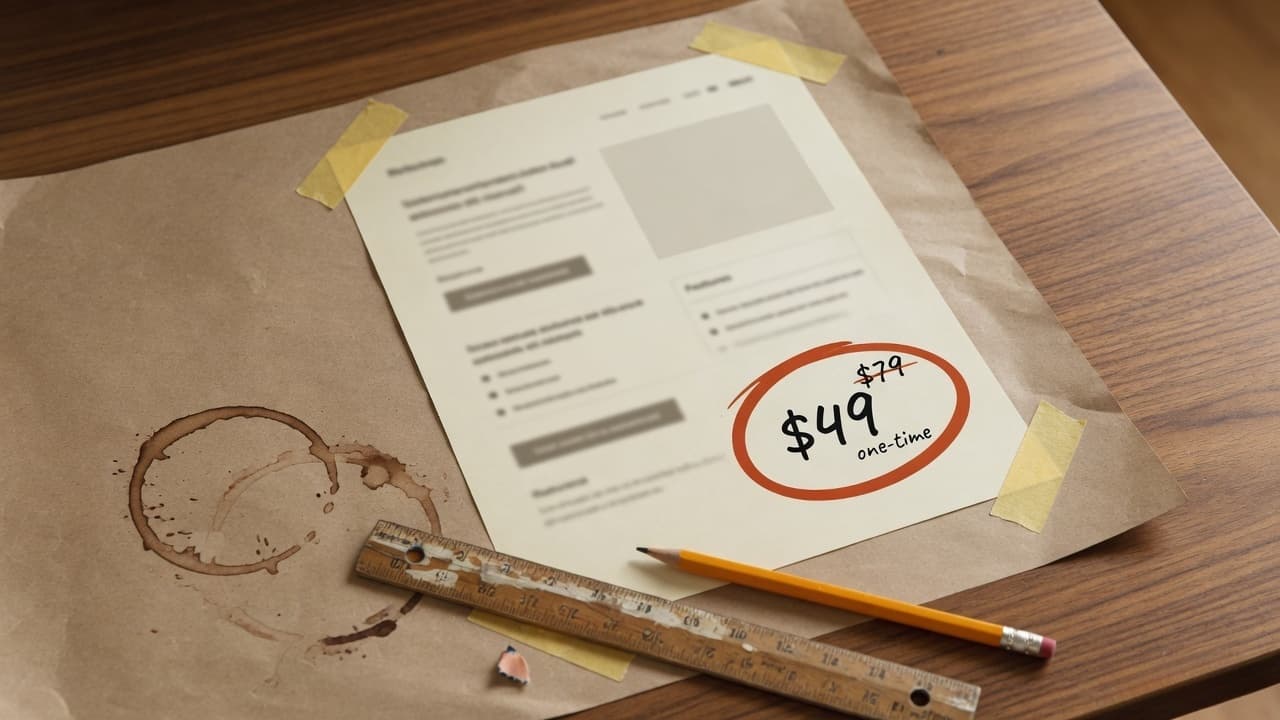
A sentence without a price is a hobby description. Buyers need a number so they can decide if this is serious. Patrick McKenzie has been saying for years that you can probably stand to charge more. Price on the value the customer gets, not on how long you took to build it. If you leave the price out, people guess you are free or they wait for a quote you never send. Put the number in the line.
You do not need perfect packaging. Monthly, annual, or a setup fee is fine for the first version. You need a number you can say without flinching. If you charge $10, they treat you like a $10 vendor. If you hide the price until a “custom quote,” many indies never send the quote.
The formula
Write it in this shape until you have a reason to change it:
I help [who] [stop / fix / finish] [pain in their words] for [price].
Three filled examples. Use them as shape, not as copy for your product:
- I help clinic office managers cut phone-tag scheduling for $149 a month.
- I help freelance bookkeepers collect late invoices without chasing clients in email for $79 a month.
- I help three-person design studios send brand assets without digging through Slack for $99 a month.
Notice what is missing: easy, free, AI-powered, all-in-one, next-generation. Notice what is present: a buyer, a mess, a number.
Bad sentence, fixed sentence
Run yours through this filter. If it fails, rewrite before you touch Figma.
- Bad: “An AI platform that makes work easy and fast.” Fix: name who, name the work that breaks, name the price.
- Bad: “Notion for X, but better.” Fix: say the job they hire you for without leaning on another brand.
- Bad: “We empower teams to unlock productivity.” Fix: cut every verb you would not say to a friend.
- Bad: “Free forever for individuals.” Fix: if free is a plan, the sentence for paying buyers still needs who, pain, and price.
- Bad: feature parade in one breath. Fix: one outcome. Features wait for the second sentence.
Scripts you can use this week
Write the sentence once. Then use the same sentence in every channel. Do not invent a new pitch for email, Twitter, and the call.
I help [who] [pain in their words]. It is [price]. If that is your mess, I can show you in 15 minutes.
Hey [name]. You mentioned [pain in their words]. I built a small tool for [who] that does that for [price]. Want a 15-minute walkthrough this week, or should I leave you alone?
Saw your note about [pain they posted]. I help [who] with that for [price]. Happy to show the one screen that removes it. If I have the wrong person, who should I talk to?
[Product] helps [who] [outcome in their words]. [Price]. [Clear button: Start / Book / Pay].
The homepage is not a different product story. It is the same sentence with room for proof under it. If the hero needs a paragraph to make sense, the sentence is not done. Put that line on one page with a price and send it.
Test it before you polish the brand
Say the sentence to five people who match the who. Do not send a deck. Watch what they do. Useful reactions: they lean in, they ask the price before you finish, they name a coworker who has the same mess. Useless reactions: polite smile, “cool idea,” questions only about your stack. Compliments are not a yes.
- Write three versions on paper. Read each out loud once.
- Pick the one you can say without looking down.
- Send it in five personal notes this week. No mass sequence.
- After each reply, write the exact phrase they used for the pain.
- Replace your middle clause with their phrase. Keep the price unless the wrong buyer keeps showing up.
Paul Graham’s line still holds: you cannot wait for users to come to you. You go get them. The sentence is what you say when you get there. It does not replace the ten conversations. It makes those conversations start in the right place.
Where the sentence goes next
Once you can say the line out loud, put it everywhere a stranger first meets you: bio, hero, cold note, invoice description, intro at a meetup. Keep the words stable for two weeks so you can tell what is broken: the sentence, the who, or the product.
Then do the work the sentence points at. How to get your first 10 paying customers without ads is the field guide for the notes, the calls, and the ask. A sharp sentence with zero sends still earns zero.
A one-week plan
- Day 1. Write who, pain, and price on one line. Ban easy, fast, free, simple, secure as the lead words.
- Day 2. Say it to two people who match the who. Record the phrases they use back.
- Day 3. Rewrite only the pain clause. Put the sentence on the hero and in your bio.
- Day 4 to 6. Send five notes that open with the sentence and ask for 15 minutes.
- Day 7. Count replies that name the pain or ask about price. If you have none, change the who or the pain, not the color of the button.
What to stop doing
- Leading with AI, platform, or ecosystem when nobody asked.
- Hiding price until a demo you never book.
- Writing a sentence for “everyone” so you do not have to choose.
- Testing five headlines a day while you have sent zero personal notes.
- Explaining architecture before the buyer hears the pain you remove.
- Using easy, fast, and free as the whole pitch.
Then you can sell it
One sentence will not sell the product for you. It stops you from shipping a product you cannot explain. Write who, pain, and price in One sentence. Drop the empty words. Say the line until a real buyer leans in. When someone pays, write the story. You can join Indiecity while you test the sentence. The join does not write the line for you.
Until then, say the sentence out loud once more. If you need a breath mid-way, cut it again.
FAQ
Questions people get stuck on
Is a tagline the same as the one sentence?
No. A tagline is branding. The one sentence is a sales line: who pays, what pain you remove, and what it costs. You can have a short product name and still need a full sentence for a call or a DM.
Why put the price in the sentence?
Price is part of the offer. If you hide it, people guess wrong or treat you like a free tool. Patrick McKenzie has written for years that you can probably stand to charge more, and that a low number trains people to treat the work like a cheap thing. Say a real price you can defend on a call.
What if I sell to more than one kind of customer?
Pick the one who already pays or who should pay first. Write the sentence for them. A second buyer gets a second sentence later. One vague sentence for everyone means nobody hears themselves in it.
Can I say easy, simple, or free if that is true?
Do not lead with those words. Ramit Sethi and Patrick McKenzie said it flat: easy, fast, and free should never be the headline or subhead. They do not describe a real pain. Use the words your buyer already uses for the mess they have.
How long can the sentence be?
One breath. If you need a second breath, cut a clause. You should be able to say it on a call without reading notes. If a stranger asks what you do, this is the answer before you open a deck.
What if nobody reacts when I say it?
The who is wrong, the pain is yours not theirs, or the price is missing. Ask them what they heard. Change one part. Say it again to the next person. Do not fix it by adding features to the product first.
Do I need April Dunford’s full positioning workshop for this?
Not for day one. Dunford’s point still holds: you need a well-defined set of customers who care a lot about something you lead at. The one sentence is the short form of that. Run her full process when you have more products or segments. Start with who, pain, and price.
Where does this fit if I already shipped and have zero buyers?
Write the sentence before you rewrite the app. Then use it in the ten notes you send people who already have the pain. Getting your first ten paying customers without ads is the next job after the sentence is clear.
Should the sentence name my product or category?
Name the outcome and the buyer first. Category language helps later for SEO and stores. On a cold call or a DM, people care who it is for and what stops hurting, not whether you call it a platform.