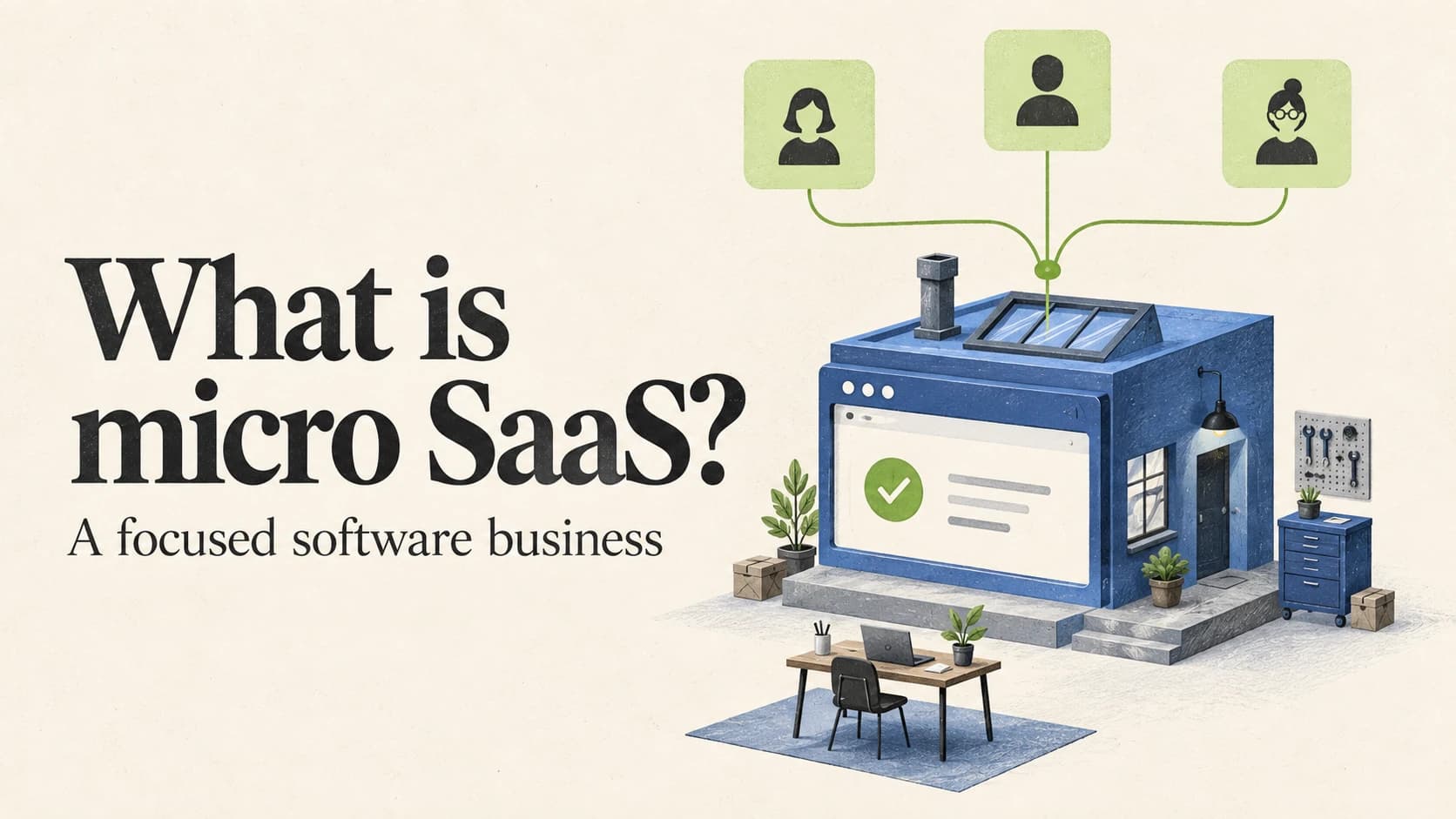
Micro SaaS is a small software-as-a-service business that solves a focused problem for a defined group of customers. It is typically run by a solo founder or a small team, with a limited product scope and lean operations. Customers usually pay through subscriptions or usage-based charges.
Think of a tool that keeps a retailer’s store locator up to date, rather than a system that runs its entire business. The opportunity is specific enough to explain, sell and support without building a large company around it.
That can make micro SaaS appealing to independent founders. It still requires the work of a business: finding customers, delivering a reliable service and giving people a reason to keep paying.
What makes a SaaS business “micro”?
SaaS describes software delivered as an online service, with the provider operating the application and underlying infrastructure. Subscription and pay-as-you-use pricing are both common. AWS’s SaaS definition explains this delivery model.
The “micro” part describes the business’s scope and operating footprint.
In his early explanation of micro SaaS, founder Tyler Tringas described a niche software business with a small team, modest costs, focused functionality and no outside funding. His experience building Storemapper helped make that model concrete.
That is a useful starting point, rather than a formal certification. For this guide, the practical characteristics are:
- A defined buyer: you can name the people or businesses the product serves.
- A bounded job: the product handles a specific workflow or closely related set of tasks.
- Ongoing value: customers have a reason to continue using the service.
- Lean delivery: a small team can maintain, sell and support it.
- Manageable economics: serving customers leaves enough money and time to keep operating.
There is no revenue threshold in Tringas’s definition. A low-revenue app can be expensive and complicated to run; a higher-revenue product can remain tightly focused. Revenue alone tells you little about operating complexity. If that named group is one trade, the pick is how to pick a vertical SaaS one person can sell.
Micro SaaS vs. SaaS, side projects and startups
These terms answer different questions. SaaS describes delivery. Micro SaaS describes a focused business model. A side project describes where work fits into someone’s life. Startup often describes growth ambition.
| Term | What it describes | What it does not establish |
|---|---|---|
| SaaS | Software operated and delivered as an online service | Team size, profitability or funding |
| Micro SaaS | A focused SaaS business with lean operations | A guaranteed income or a fixed revenue ceiling |
| Side project | Work pursued alongside a primary commitment | Whether it has customers or earns money |
| Startup | In a growth-oriented definition, a company designed to expand rapidly | Whether it has raised venture capital |
A profitable micro SaaS can remain its founder’s side project. A bootstrapped company can pursue startup-scale growth. Paul Graham’s growth-based definition of a startup explicitly does not require venture funding.
Also distinguish the product from the evidence behind it. A working product can exist before its first sale. That sale demonstrates willingness to pay under a particular offer. Continued use and renewal provide stronger evidence that the business can last.
“Pre-revenue SaaS product” is a clear description when the software works but commercial demand remains unproven.
Examples that make the model easier to understand
Storemapper: a specific job for merchants
Storemapper provides store-locator software that businesses can add to their websites. The buyer wants visitors to find relevant physical locations without commissioning and maintaining a custom locator.
It illustrates a useful product boundary: handle location discovery well. The business does not need to offer inventory management, payroll and accounting to be useful.
Storemapper is also the historical example behind Tringas’s writing. That history should not be taken as proof of its current ownership, staffing or revenue.
Early Plausible: a focused alternative
Plausible’s company history says it began in 2018 as a solo-built, privacy-friendly alternative to Google Analytics, launched paid subscriptions in 2019 and added a second founder in 2020.
The useful lesson is the focused entry point: a simpler way to understand website traffic. This is an example of how a lean software business began, not a claim that it must remain “micro” forever.
Three hypothetical opportunities to investigate
These are research starting points, not validated business ideas.
| Possible product | Specific buyer | Repeated job | Main uncertainty |
|---|---|---|---|
| Failed integration alerts | Agencies maintaining client automations | Detect failures and notify the right person | Whether existing monitoring is already sufficient |
| Client approval reminders | Small video-production studios | Collect feedback and chase overdue approvals | Whether clients will adopt another tool |
| Supplier-feed checks | Retailers importing supplier catalogues | Flag missing or inconsistent product data | Whether supplier formats make support too costly |
An idea becomes more interesting when you can inspect the current workaround, identify who owns the budget and explain why existing software leaves the problem unresolved. For more starting points, use the micro SaaS idea filters for a solo founder.
Benefits and tradeoffs of staying small
A narrow product can reduce the number of workflows you need to build and support. It can also sharpen marketing: a buyer can recognise their problem in a sentence. A founder who understands the niche can make product decisions directly, without layers of internal coordination.
Those advantages come with constraints.
A niche can be too small. A few enthusiastic users may not support the income you need. Estimate the number of reachable buyers and a plausible price before extrapolating from early interest.
The founder can become the bottleneck. Support, sales and outages compete with development time. A business that requires your attention every evening may be profitable on paper but incompatible with your life.
A platform can control your access to customers. An integration or marketplace app can reach a platform’s existing customers while depending on its APIs, permissions and distribution rules.
A large customer can pull the product off course. If each sale requires a custom workflow, the business may start behaving like a service agency. That can be a valid business, but it changes capacity and pricing.
A larger vendor can add the feature. Investigate why customers would still choose your product: a better fit for their workflow, stronger integration, trusted support or meaningful depth within the niche.
How to choose a micro SaaS problem
Start with a task you can observe. “Software for agencies” is too broad to investigate. “Helping small video studios collect a final approval before delivery” gives you a buyer, a workflow and a moment of pain. Your own tools and invoices can help you find a SaaS problem you already pay to solve.
Before committing, answer five questions:
- Does the problem recur? Look for a weekly, monthly or event-triggered job. An occasional task may fit a one-time product better.
- What does the buyer do today? A spreadsheet, manual checking or paid assistance gives you a concrete alternative to evaluate.
- Who can approve the purchase? The user and budget owner may be different people.
- Can you reach those buyers? Identify a community, search query, partner network or marketplace where the problem is already discussed.
- Can you serve them within your capacity? Consider onboarding, integrations, data sensitivity and support expectations alongside coding effort.
Treat a weak answer as something to investigate. Avoid inventing a scoring formula that turns guesses into apparent certainty.
For a more detailed research process, use Indiecity’s guide to validating a SaaS idea before writing code.
How much can a micro SaaS earn?
Earnings depend on customer count, pricing, retention, delivery costs and the work required from the founder. A revenue screenshot cannot answer whether a business is sustainable.
The billing model matters as much as the amount. Compare SaaS pricing models for bootstrapped products to decide whether a fixed subscription, seats, or usage best fits your customers and delivery costs.
If you are new to the metric, start with what MRR includes and which number to watch. You can then use MRR Maker to calculate your own subscription revenue. For a simple flat-rate subscription:
Monthly recurring revenue = paying accounts × monthly subscription price.
Consider this hypothetical business. These are illustrative assumptions, not industry averages or an earnings forecast.
| Monthly item | Illustrative amount |
|---|---|
| 100 accounts paying $29 each | $2,900 revenue |
| Hosting and database | $120 |
| External APIs | $180 |
| Payment and billing fees | $110 |
| Support and operating tools | $90 |
| Acquisition spending | $300 |
| Cash remaining after these listed expenses | $2,100 |
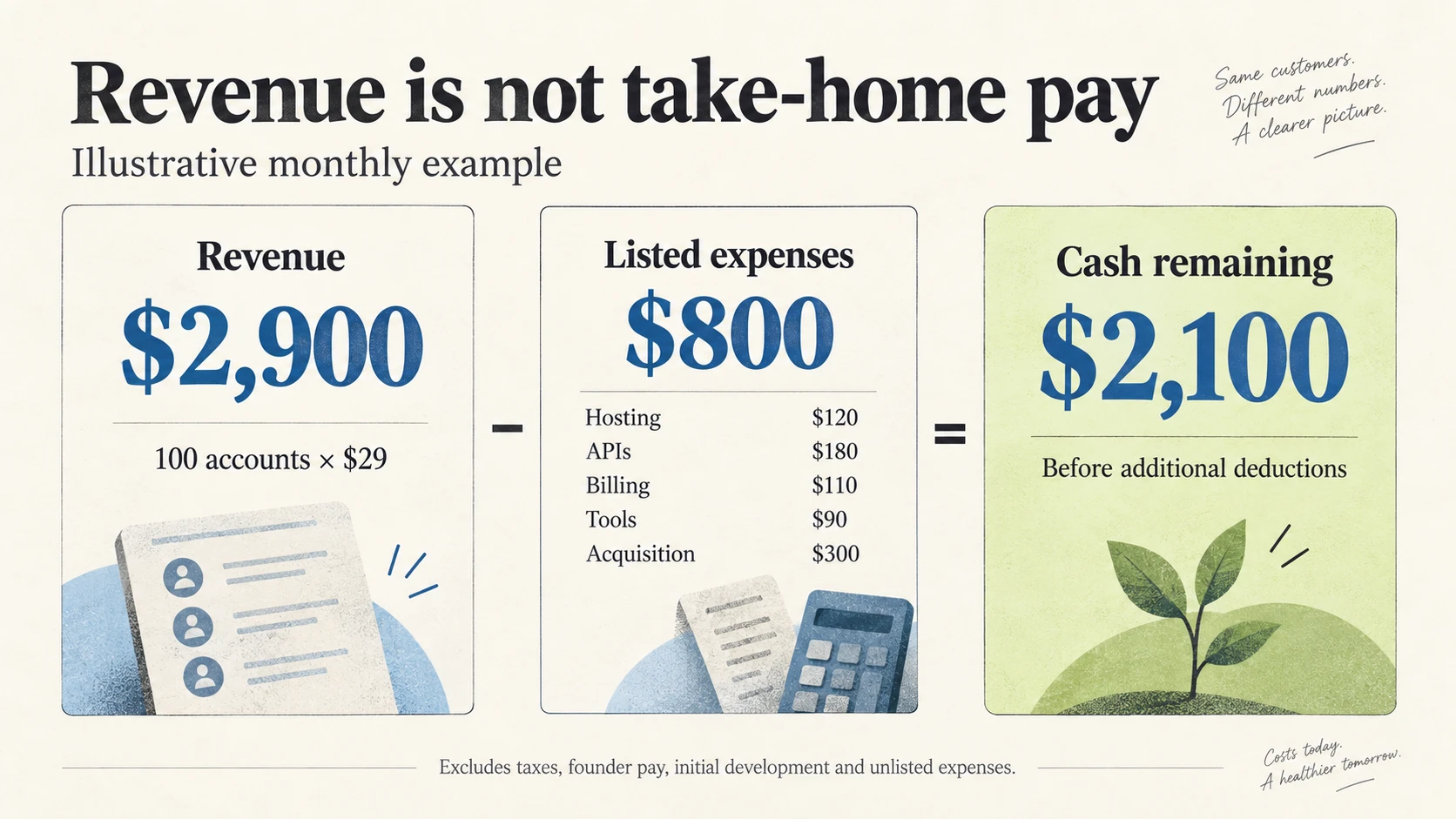
That $2,100 is before taxes, founder compensation and any unlisted expenses. Initial development costs are also excluded.
If the founder spends 60 hours that month on the business, the remainder is equivalent to $35 per hour before those additional deductions. If support demand doubles, the workload changes even when subscription revenue does not.
Retention changes the calculation too. If five of the 100 starting customers cancel during a month, customer churn for that group is 5%. At the same price, replacing them requires five new customers just to restore the lost $145 in monthly recurring revenue.
Use your own assumptions to estimate the business you actually want to operate. Include the cost of acquiring customers and the time required to keep them.
How to price a micro SaaS
Start with the value of the job and the costs of providing it. Ask what the buyer currently spends in time, money or avoidable errors, then test a clear paid offer.
| Pricing model | When it may fit | What to watch |
|---|---|---|
| Flat monthly or annual fee | Customers receive similar value at similar usage levels | Heavy users may cost much more to serve |
| Usage-based | Consumption varies substantially, such as processed documents | Buyers need understandable units and bill visibility |
| Base fee with usage allowance | There is ongoing account value plus variable delivery cost | Allowances and overages must be easy to explain |
Stripe’s usage-based billing documentation describes charging according to product consumption. A fixed monthly subscription is not the only way to charge for SaaS.
For an early offer, make the price, included usage and promised outcome explicit. Watch whether customers understand the offer and whether their actual usage leaves room to support them.
Treat lifetime deals carefully. Upfront cash can help fund development, while hosting, API and support obligations continue. Calculate the likely cost of those obligations before offering indefinite access.
How to validate and launch without overbuilding
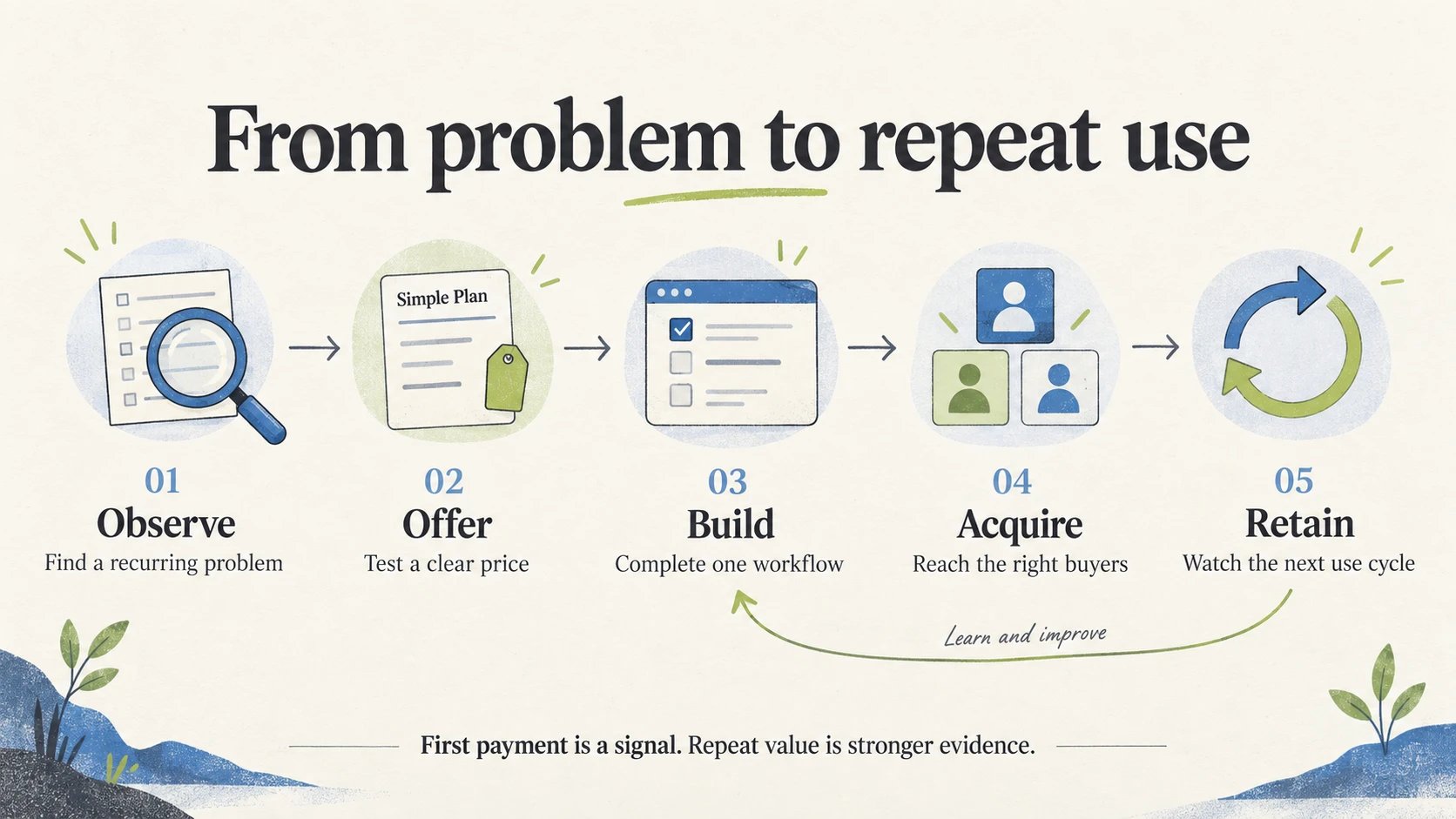
Use milestones based on evidence rather than a promise to launch in a weekend.
1. Inspect the existing workflow
Ask prospective customers to describe the last time the problem happened. Where did the work start? Which tools did they use? What went wrong? Who handled it?
Specific recent behaviour is more useful than a general answer to “Would you use this?”
2. Test a defined offer
Describe the buyer, outcome, scope and price. Show a prototype or offer a clearly described pilot. Explain which parts work and which require manual assistance.
A signup expresses interest. A paid pilot is stronger evidence of willingness to pay, but it still does not establish long-term demand.
3. Build one complete workflow
The first version should let the customer accomplish the promised job from beginning to end. For approval software, that might mean sending a review request, collecting a decision and recording the result.
Custom themes and a large integration catalogue can wait unless they are necessary for that outcome. Account access, customer data and payment behaviour deserve attention from the start.
4. Find customers through a repeatable route
Choose an initial channel based on where buyers already look for help:
- A platform’s app marketplace for a product that extends that platform.
- Direct conversations for a narrow group of identifiable businesses.
- Search content for a problem buyers already describe consistently.
- Partnerships with specialists who implement the surrounding workflow.
Rob Walling’s Stair Step Method recommends starting with manageable products and a focused acquisition route. His early steps can include non-SaaS products; a subscription business is one possible progression.
For outreach examples, continue with getting your first ten paying customers without ads.
5. Observe the next natural use cycle
Find out whether the buyer completes the job again when it recurs. A monthly reporting tool should be evaluated around reporting cycles; daily logins would be a poor measure of its value.
Record what required your help, what the customer ignored and why anyone stopped. Decide whether to improve onboarding, change the offer or reconsider the problem before adding more features. Use onboarding without a customer success team to shorten the path to the first useful result.
What you need to operate after launch
The right tool stack is one you can maintain and troubleshoot. Whether you use custom code, no-code tools or AI assistance, you still own the customer experience.
Before expanding, make sure you can answer these practical questions:
- Can a customer sign up, recover access and complete the main task?
- Do you know when a background job or integration fails?
- Can you restore important data from a backup you have tested?
- Are customers’ accounts and data appropriately separated?
- Can customers understand their charges and cancel their subscription?
- Is there a clear support route and a response expectation you can meet?
- Can you explain what data you collect, which providers receive it and how deletion or export works?
- What happens if you are unavailable or decide to close the service?
Data sensitivity and customer requirements affect how much operational work is needed. Include that work in the scope before accepting customers whose needs exceed your capacity.
Can you build micro SaaS with AI or no-code tools?
Yes. The implementation method does not determine the business category. A no-code application or an AI-powered service can serve a narrow market with a small team.
For AI features, test the actual customer task. Track output quality, latency, retries and cost per completed job. Give users an appropriate way to review uncertain results, and understand how your providers handle the data you send them.
For no-code systems, examine what happens as usage grows: plan limits, integration failures, data export and any workflow that still requires your intervention. Compare no-code and code for a first SaaS before committing to a build path.
A faster build helps you reach the test sooner. Buyers still need a useful result, and you still need a service you can afford to deliver.
How to tell whether the business is working
Use a compact set of measures that reflects the customer’s job:
| Measure | What it helps you understand |
|---|---|
| Activation | Whether a new account reaches its first useful outcome |
| Repeat use | Whether customers return when the job recurs |
| Renewal and cancellation | Whether the ongoing offer remains worth paying for |
| Recurring revenue movement | How new sales, expansion, downgrades and cancellations change revenue |
| Delivery cost and support time | Whether growth is manageable for your operation |
| Acquisition effort and cost | Whether you can repeat the process of finding customers |
| Customer concentration | How exposed you are to losing a major account |
With a small customer base, pair percentages with counts. One cancellation out of ten customers is a 10% loss, but the reason for that one departure matters more than an isolated percentage.
Choose a problem you can keep solving
A promising micro SaaS has a buyer you can reach, a job worth paying for repeatedly and delivery requirements you can sustain.
Write down the buyer, the recurring task, the current workaround and a proposed price. Then find someone who has recently done that task and learn what happened. That conversation gives you something concrete to test before you commit to building the business.
FAQ
Questions people get stuck on
Is micro SaaS passive income?
Plan for ongoing work. Billing can recur automatically; support, reliability, acquisition and product maintenance still need an owner. The useful goal is a manageable operation with enough margin to fund that work.
Do I need to know how to code?
You need a reliable way to build and maintain the service. That may involve your own development skills, a partner, contractors or no-code tools. Include maintenance capacity and cost in the decision.
Is a browser extension or plugin a micro SaaS?
It can be part of one. An extension that depends on an ongoing hosted service may fit. A downloadable utility sold once is a software product, but the format alone does not make it SaaS.
How much money do I need to start?
Prepare a budget for your particular product: development, hosting, providers, billing, support, acquisition and the time before revenue covers costs. A simple workflow and a data-intensive AI service can have very different requirements. A universal startup-cost estimate would hide those differences.
Can a micro SaaS become a larger business?
Yes. You can add adjacent workflows, expand the market or hire people as demand supports it. Revisit the operating model when those decisions change the scope or workload.