You have a job. That paycheck pays rent while the product is still ugly. The fantasy is that if you quit, you will suddenly have focus. Most people get empty days, shrinking savings, and a product that still has no buyers.
Pieter Levels put it plainly in May 2026: build on the side until the thing makes equal or more money than your main job or freelance gigs, and that money is stable. Then quit and switch. He wrote that he does not know people who quit to live off savings and built something that paid before the savings ran out, except one named exception. He still thinks that order is wrong.
Keep that order. Nights and weekends. Keep the job. Ship a small SaaS until someone pays. Indiecity is for one person or a team under twenty. You do not need a growth team. You need protected hours and a price.
Why you do not quit early
Levels’s argument is not romantic. Unemployed days feel free. Days with no clock often make people lazy. You need constraints. A job forces you to pick the few moves that matter because you only have a few hours. That pressure is useful.
I think you should build something on the side and once it makes equal or more money than your main job or freelance gigs and it's stable, quit the job and switch.
He is not guessing from a textbook. He had income from his YouTube channel Panda Mix Show in 2013 when he started building. It still took over a year before he made enough to switch. The side path is slow. Slow and solvent beats fast and broke.
In 2026 more people fall for that trap. Everyone can ship an app. Levels wrote in June 2026 that almost nobody has an audience, money for ads, or a free way to get seen. Indie meetups fill with people building AI factories with no money and no traffic. Quitting does not get you buyers. Talking to them does. The job is what lets you keep talking.
What the job is for
The job is not the enemy of the SaaS. The job buys you time to be wrong without wrecking your life. You can ship a bad landing page on Saturday and still eat on Monday. You can send ten notes and hear silence without also panicking about rent.
Protect that. Do the day job well enough that it stays. Do not use company time, company data, or company customers for the product. Do not compete with your employer in a way that gets you fired mid-build. A clean side project is boring. Boring is how you stay employed while the product grows.
Read the employment contract before you write serious code. Some companies claim ownership of work you invent while employed. If the clause is broad, get advice. Build something you can own, or wait until you can. Ownership is not a detail you fix after launch. Once you can own the work, the next fight is the calendar.
Protect hours. Do not invent a fake schedule
People love to prescribe “two hours every night.” That is not a rule. It is one person’s diary. You do not need a stranger’s hours. You need a block you can repeat when life is normal, not only when you feel heroic.
In 2022, James Fleischmann collected how builders actually juggle a job. The clocks still match 2026. Allison Mui put the side project first in the day because after work she had no mental energy left. Felix Wong finished the day job at 6:30 and started the product at 8:00. James himself preferred mornings and Saturday. Same problem, different hours. Copy the idea of a protected block. Do not copy their hours.
Indie Hackers · u/James Fleischmann
How to juggle a full-time job with a side-projectMornings, evenings, weekends. Different people, different peaks. The shared rule is a protected block and high-impact work inside it.
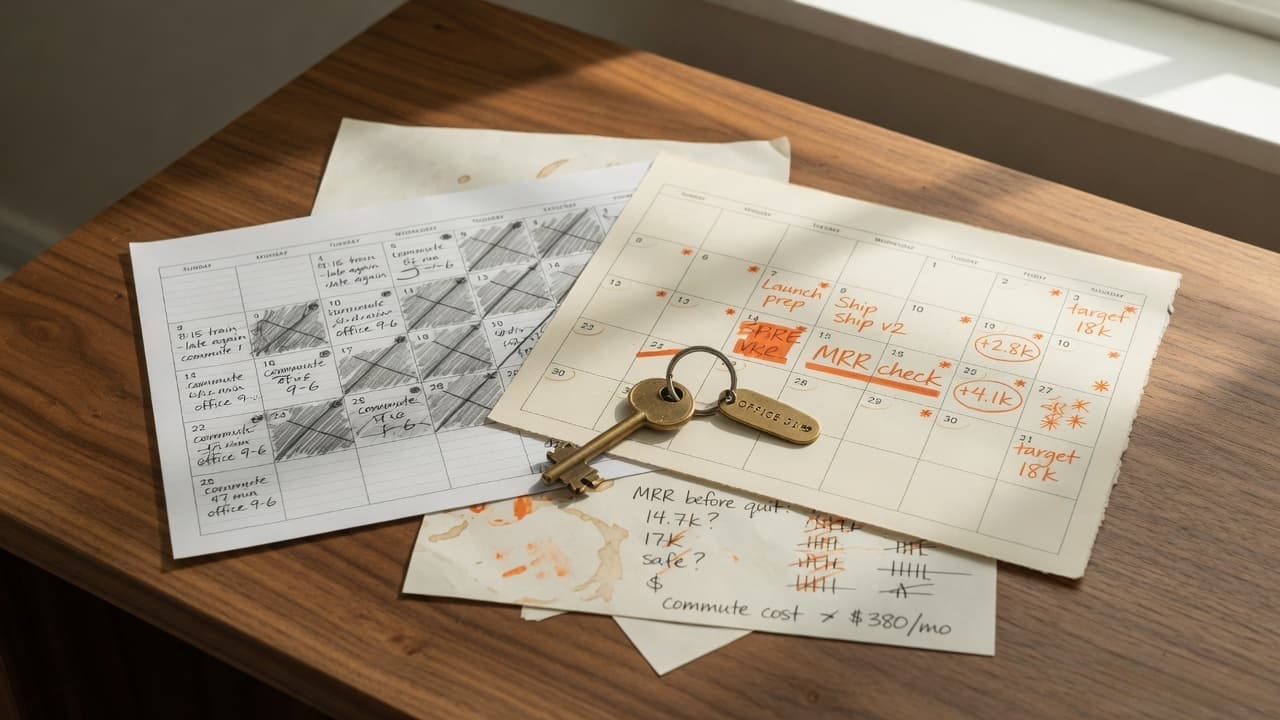
Pick your peak. Morning if the job drains you. Night if that is when you wake up. Weekend mornings if weekdays are chaos. Write the block on a calendar like a meeting you cannot skip. Then show up for the product, not for the internet.
Spend scarce hours on money, not polish
With a few free hours a week you cannot build a platform, a brand, and a content engine. You can do one job: make something someone will pay for, then ask them. Paul Graham’s line still holds: you cannot wait for users to come to you. You go get them. That work is uglier than coding. It is also the work that turns a side project into a business.
In 2026, code is the cheap part. AI writes the CRUD. Templates ship a page. The expensive part is attention and trust. If your side hours go only into features, you are doing job work for no pay. Put the price on a page. Make a payment link. Send notes to people who already have the pain. Start with one person who pays, then run the same notes until you have ten without ads. The salary still covers life while you do it.
A useful split for a week with a job:
- One block: write or rewrite the offer. One sentence outcome. One price. One who.
- One block: talk to people. Messages, short calls, replies in rooms where buyers already complain.
- One block: ship only what those people blocked on. Not the roadmap fantasy.
- Zero blocks: redesigning the logo, rebuilding the stack, or watching another “quit your job” video.
If a block has no next action written before it starts, you will open the editor and “improve” something nobody asked for. Write the action the night before. Name, message, bug, price. Then run it.
Build the smallest thing you can charge for
A side SaaS dies when the MVP is a second full-time product. Cut until a buyer can use it this month. Manual steps are fine. Spreadsheets behind the UI are fine. Doing things that do not scale is how early products survive when you have a day job. You will not hire a team at 11pm. You will answer email yourself. Define the deliverable with how to build an MVP you can charge for.
Ship something chargeable before you ship something pretty. A payment, an invoice, a transfer. A waitlist is not a business. A free user who loves you is not proof. Money is proof. Take it the same day someone says yes.
For [who] who still [pain in their words], I do [outcome] for [price]. Start this week: [what they get in the first 7 days]. Pay here: [link].
That page is enough to start conversations. You can rebuild it after three people pay and tell you which sentence was wrong.
Sell in the cracks of the week
Sales with a job means short, specific, human. Not a mass sequence written by ChatGPT. Ten personal notes beat two hundred identical ones. Lunch, a parked-car message, Saturday morning: that is when you sell.
Hey [name]. You mentioned [pain] last time. I built a small tool that does [outcome] for [who]. It is [price]. I can show you in 15 minutes this week (early morning or evening). If it is not a fit, who else has this mess?
Book calls at edges of the day so you do not vanish from your job. Fifteen minutes. Show the one thing that removes the pain. Say the price. Stop talking. Get the payment while they care. Then ask for one intro. That loop is how side builders grow without a marketing budget.
Keep a simple sheet: sent, replied, booked, paid. If “sent” grows and “paid” stays at zero, change the offer or the buyer. Do not add features to avoid the sheet.
A four-week side plan
- Week 1. Write the offer with a price. Check the contract. List 30 names. Set two protected blocks on the calendar.
- Week 2. Ship the smallest chargeable version. Payment link live. Send ten personal notes. Run any call that books.
- Week 3. Fix only what blocked a real person. Send the next ten notes. Ask every payer for one intro.
- Week 4. Count paying customers and monthly revenue. Rewrite the page with their words. Decide: keep the loop, change the buyer, or kill the idea. Do not quit the job on a feeling.
Repeat the loop. Months of this beat one dramatic resignation. When revenue shows up and sticks, the quit question becomes math, not mood. That is the moment for how much MRR before quitting your job.
How you know it is working
You protect the block most weeks. People reply. Someone takes 15 minutes. Someone pays. Revenue repeats without you begging every month. Those are the signals. “I almost finished the rewrite” is not a signal.
If you never send the notes, you are not building a SaaS on the side. You are keeping a hobby that looks like work. The job is fine. The missing ask is the problem.
What to stop doing
- Quitting to “give it a real shot” before anyone paid.
- Building a second full-time product after hours.
- Copying someone else’s hour count and feeling guilty when life does not match.
- Spending every block on features and zero blocks on asks.
- Using company time, lists, or customers for the product.
- Waiting for a launch day to replace conversations.
- Starting three side products so none of them gets a protected block.
Keep the job until the product pays
The hard part is not motivation quotes. It is showing up on a Tuesday night when the job already took your brain, and still sending two notes. It is shipping a thin product and charging for it. It is waiting until the money is real before you burn the paycheck.
Levels’s 2026 rule is simple: build on the side until it makes money, then switch. The job funds the experiment. Use it. When you have a story with real revenue and your name on it, send it in. When the product is real, put it on the map. You can join Indiecity while you still have the day job. That gives you people to talk to. The block on the calendar is what ships.
Tonight, write the offer. Tomorrow, protect one hour. Do not quit first.
FAQ
Questions people get stuck on
Should I quit so I can build faster?
No. Quitting does not make the product real. Revenue does. Pieter Levels wrote in May 2026 that you should build on the side until the product makes equal or more money than your job, and that income is stable, then switch. Empty days without a clock often make people slower, not faster.
How many hours a week do I need?
There is no number that works for everyone. Do not copy a stranger’s schedule and call it a plan. Pick the hours when you still think clearly (early morning for some people, late night for others) and protect them. Ship the next customer step in those blocks. Consistency beats a heroic week you cannot repeat.
What if my employer owns what I build?
Read the contract before you write the first line. Some employers claim IP you create while employed, even on your own machine. If the clause is broad, talk to a lawyer or build something that clearly sits outside the claim. A product you cannot sell is not a side business.
Is nights and weekends enough in 2026?
Yes, if you spend those hours on the right work. Building got cheap. AI writes a lot of the boring code. The scarce work is still finding people who pay and asking them for money. A full calendar of free time spent polishing features still ships zero customers.
What should I do with a two-hour block?
One job per block. Write the offer with a price. Send three personal notes. Book or run one short call. Fix the one bug a paid user hit. Do not open the editor to “improve the architecture” unless a buyer is blocked. Time is the constraint. Spend it on money, not polish.
Can I sell to people at my day job?
Be careful. Selling inside your employer can look like a conflict, especially if the product touches the same market. Prefer buyers outside work. If a coworker has the problem in their own life, outside work hours, keep it personal and check your policy. Do not use company lists or company time to sell.
When can I quit?
When the product pays you enough, for long enough, that losing the paycheck does not panic you into bad decisions. Levels’s bar is equal or more than the job, and stable. The number is personal. The money side of that call is how much MRR you need before you quit.
I am dead after work. What then?
Move the product block to when you are still sharp. Many people do better before the job than after it. Cut one optional evening (TV, doomscrolling, a third side idea) and put the product there. If you cannot find any protected block for months, the problem is not the SaaS idea. It is the calendar.
What if I have zero paying customers after months?
Count conversations, not calendar months. If you never asked anyone to pay, you did not run the experiment. Get your first 10 paying customers without ads, then decide if the offer is wrong. Do not quit the job to escape that work. Quitting only removes the salary that lets you keep going.