
Yes, build in public still works in 2026, but not like it did in 2020. Posting daily revenue screenshots and "day 47" updates no longer earns attention by itself. Feeds are ranked by algorithms, flooded with AI-written posts, and full of founders doing the same thing. What works now is closer to founder-led growth: you are the recognisable face of the product, you show up every week with something genuinely useful, you join the conversations people are already having, and you accept that a small number of breakout posts will do most of the work.
That is our take at Indiecity, and the rest of this piece explains why we hold it. We separate evidence from opinion as we go: platform changes and studies are cited, and our own judgement is labelled as such.
What building in public meant in 2020
Building in public means sharing how you build a business while you build it: the product decisions, the numbers, the mistakes. It predates the hashtag. Buffer published every employee's salary in 2013. Baremetrics made its revenue dashboard public and started an Open Startups list; very few companies joined it, which was part of why it stood out. Pieter Levels shared his path to $1 million a year with public revenue pages.
Around 2020 and 2021 it became a movement on Twitter, and it worked unusually well. Tony Dinh grew from 100 to 10,000 followers in six months; one tweet about a feature on his profile banner brought him 4,000 followers in under 48 hours, while the product behind it made about $350 a month. Transparency was rare, so it was interesting. The timeline was largely chronological, so followers saw what you posted.
What changed
The feeds are ranked, and reach is uneven
In January 2023, Twitter made its algorithmic "For You" feed the default. In January 2026, X open-sourced a ranking system that relies on a Grok-based model predicting engagement. Being followed no longer means being seen.
Paying helps a lot. Buffer's analysis of 18.8 million X posts from August 2024 to August 2025 found median impressions per post under 100 for free accounts, about 600 for Premium and over 1,550 for Premium+, and a median engagement rate of 0% for free accounts. Buffer notes this is correlation, not proof that paying causes the reach.
LinkedIn went a different direction. In 2024 it said its feed would favour "uniquely useful" knowledge over trend-chasing, and in March 2026 it rebuilt the feed with language models, promising to show relevant posts on breaking news "within minutes, not hours" while suppressing repetitive, click-driven posts.
AI filled the feeds
Estimates of how much social content is AI-written vary widely by detector, but all are high. Pangram's analysis of more than a million posts, reported in July 2026, found 41% of long LinkedIn posts were fully AI-written. Originality.ai put the share of long LinkedIn posts it tested at 81%. Both companies sell detection tools. The honest summary: somewhere between four and eight in ten long posts on LinkedIn are now likely written by AI.
The platforms are pushing back. In July 2026 LinkedIn added a button to report posts that "seem like AI slop"; within weeks, it said, views of low-quality content had fallen 40%. The same month, X's head of product said the company had removed 42,000 accounts automating replies with chatbots. The web shows the same pattern: Graphite found that AI-written articles overtook human ones in volume in late 2024, yet 86% of articles ranking in Google were human-written.
Our reading: posting more generic content every day now puts you in the largest, fastest-growing and most actively suppressed category on every platform. Your post is a needle in a haystack that keeps getting bigger. Volume stopped being an advantage when it became free.
What still works: build in public as founder-led growth
Building in public has not died. It has changed job. It used to be a novelty that drew followers. Now it works as part of founder-led growth, where the founder's own presence is a main route by which customers find and trust the product. Andreessen Horowitz describes the same shift in its "go direct" thesis: to win, you must go direct, and to go direct, you must be interesting.
People trust people more than logos. The 2026 Edelman Trust Barometer found trust increasingly concentrated "among those closest to us". In Edelman and LinkedIn's 2024 study of B2B buyers, 73% said thought leadership was a more trustworthy basis for judging a company than its marketing materials. For a one-person SaaS, you are the thought leadership.
In practice, five habits separate the founders it still works for from the ones posting into silence.
1. Be the face, consistently
Pick one or two platforms where your customers already are and become recognisable there. Use your own name and face, a consistent angle, and a clear link between you and the product. People should be able to describe what you know in a sentence. That familiarity is what turns a random viewer into a buyer months later.
2. Show up every week, not every day
Consistency matters more than volume for a solo founder. Buffer's study of more than 100,000 users over 26 weeks found that people who posted in at least 20 of the 26 weeks got about 450% more engagement per post than those who posted in four weeks or fewer. Its advice: "You don't need a perfect schedule; you just need a sustainable rhythm."
To be fair to the other side: Buffer's LinkedIn data also shows that accounts posting more often get more impressions per post, with the caveat that low-quality posting won't deliver. Our view is that for a founder who also has to build, sell and support, one genuinely useful post a week, every week, beats daily filler. If you can post more often without dropping quality, do.
3. Post what only you can post
Generic advice is exactly what AI produces at no cost. What it cannot produce is your data, your decisions and your mistakes. The posts that hold up now are specific: the pricing change and what happened to conversions, the support ticket that changed the roadmap, the churn interview in the customer's own words. LinkedIn's own guidance points the same way: share knowledge, not engagement bait.
4. Ride the conversation that is already happening
The strongest recent build-in-public wins came from joining a live conversation, not starting a new one. On 28 October 2025, Pieter Levels complained that founders were posting fake revenue screenshots. Marc Lou built TrustMRR, a site that verifies revenue directly from payment providers, in about 24 hours and launched it by quoting Levels's post. He reported more than 2 million views and $20,378 in the first three days. His own rule: build around what people are already discussing, because "the wave does half the marketing for you".
Levels did the same in February 2025 with a flight simulator he built almost entirely with AI tools, live on X, just as "vibe coding" became the topic of the moment. He reported reaching $1 million in annual revenue in 17 days. Using a trend does not mean chasing every meme. It means noticing when the conversation touches your product and showing up with something real.
5. Let the product do some of the showing
Building in public works best alongside product-led growth, where the product itself drives discovery. Marc Lou says users of his analytics tool DataFast market it by sharing screenshots of their dashboards. Revenue badges, shareable reports, public changelogs and "made with" links all let customers build in public on your behalf.
Expect a few breakout moments, not steady growth
Social reach follows a power law: a small share of posts gets most of the attention. In AuthoredUp's sample of 476,781 LinkedIn posts, the top 5% of posts had a median of 34,121 impressions, about 69 times the 496 of a typical post. Research on Twitter found the most-followed 1% of users received about half of all retweets.
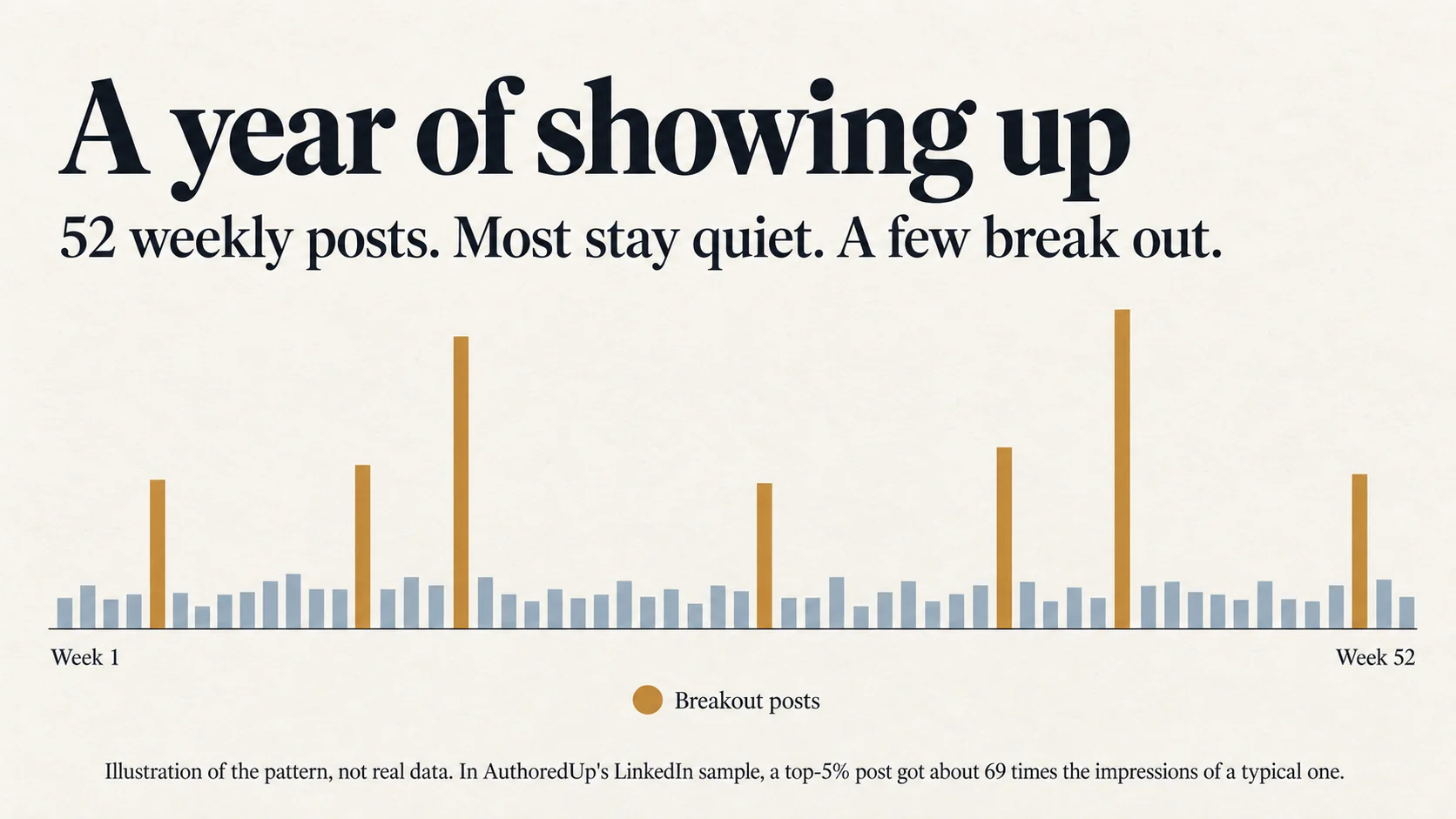
The founders' own stories match. Marc Lou says it took eight months to reach his first 1,000 followers, and his audience grew much faster only after he had shipped more than ten products and ShipFast took off. Tony Dinh's biggest early jump came from one post. Most weeks, for most founders, are quiet.
Our rule of thumb: if you show up every week for a year with something worth reading, expect roughly a handful of posts, perhaps seven, to break out. Those few moments decide the year. They bring the followers, the signups and the opportunities. This is a working estimate from watching founders, not a measured figure. But it changes how you should judge the work: a quiet month is normal, and the job is to be ready, with a product and a clear next step, when a post takes off.
What to share and what to keep
AI has made copying cheaper, which changes the risk. Arvid Kahl, who sold FeedbackPanda after building it publicly, wrote in April 2026 that founders used to stop sharing numbers around $20,000 to $30,000 in monthly revenue, but "that threshold has effectively collapsed to zero", because a product can now be cloned in days. His filter is worth borrowing: share what is "interesting to participate in" but "not easy to clone".
Others learned it the hard way. Pieter Levels described on Lex Fridman's podcast how a funded company shipped an app doing the same thing as his AI avatar product and, by his estimate, made around $30 million with it. Danny Postma stopped sharing revenue after a funded competitor copied his landing page.
| Usually worth sharing | Think twice before sharing |
|---|---|
| Lessons from pricing, positioning and failed launches | Exact revenue by product for a niche that is easy to copy |
| Customer stories and support insights, with permission | Your best-performing acquisition channel, in detail |
| Your process, tools and decision-making | Keywords, partners or distribution deals that are your moat |
| Milestones and what they cost you | Anything you would not want a competitor with funding to read |
One more risk: building in public mostly reaches other founders. A commenter in a Hacker News discussion put it bluntly: there is a "99% chance you end up building products for other indiehackers". Unless founders are your customers, check where your buyers actually spend time. For many B2B products, that is LinkedIn, a specific subreddit or a trade community, not X.
A weekly routine that fits a solo founder
- One useful post a week. Take something from that week's work: a number, a decision, a customer insight. Write it yourself. Use AI to proofread, not to have the idea.
- Fifteen minutes a day in conversations. Reply thoughtfully where your buyers already talk. Buffer found that replying to comments lifts engagement by 30% on LinkedIn and 42% on Threads.
- Watch for the wave. Keep a note of live debates in your market. When one touches your product, post quickly with something concrete, not a hot take.
- Give every post somewhere to go. A clear profile, a link to the product and an email list mean a breakout post produces customers, not just likes. Our guide to a founder newsletter that sells covers the list.
- Review monthly, not daily. Count signups, replies from potential customers and conversations started. Ignore follower counts for the first six months.
If posting publicly is not for you, it is not the only channel. Our guide to growing a SaaS without posting on Twitter every day covers support-led growth, communities and SEO, and launching with no audience covers the first customers without one.
Our take
Build in public is no longer a growth hack. It is a long-term way of being known. The founders it works for in 2026 are recognisable, consistent and specific. They post less filler and more of what only they can say, they join the conversation instead of shouting next to it, and they keep going through the quiet weeks, because a handful of moments a year will make or break the whole effort. If you are willing to do that for a year, it still works. If you want quick results from daily posting, 2020 is over.
FAQ
Questions people get stuck on
Does building in public still work in 2026?
Yes, but differently. Daily generic updates rarely get reach in ranked, AI-saturated feeds. It works when the founder becomes the recognisable face of the product, posts genuinely useful and specific content every week, joins live conversations in the market, and treats it as long-term founder-led growth rather than a quick hack.
How often should I post when building in public?
Consistency matters more than volume. Buffer found that people who posted in at least 20 of 26 weeks got about 450% more engagement per post than those who posted in four weeks or fewer. For most solo founders, one strong post a week plus daily replies is sustainable; post more only if quality holds.
Should I share my revenue publicly?
It depends on how easy your product is to copy. AI has lowered the cost of cloning software, and several well-known founders have stopped sharing detailed revenue after being copied. Share lessons, decisions and milestones freely; be careful with exact revenue in a niche a funded competitor could enter quickly.
Which platform is best for building in public?
The one where your customers already are. X still has a strong indie founder community, but free accounts get little reach. LinkedIn suits B2B products and favours useful, knowledge-based posts. For some markets, a specific subreddit or trade community beats both.
What is founder-led growth?
Growth where the founder's own presence and voice is a main way customers discover and trust the product: through posts, conversations, talks and direct outreach. It works because people trust individuals more than brands, and for a small SaaS the founder is often the most credible voice the company has.